Empathy Quotient (EQ): The Definitive Guide, Scoring Matrix, and Science
In popular culture, empathy is often reduced to a fuzzy feeling—a “soft skill” that is nice to have but secondary to raw intellect.
In psychology and neuroscience, empathy is a measurable, complex mechanism comprising both cognitive and affective (emotional) components. It is the architectural framework that allows for leadership, negotiation, and long-term relationship maintenance.
The Empathy Quotient (EQ), developed by psychologist Simon Baron-Cohen at the Autism Research Centre at the University of Cambridge, is one of the most rigorously validated psychometric instruments designed to measure this trait. Unlike general personality quizzes, the EQ was designed to quantify the specific drive to identify emotions and thoughts in others and to respond with an appropriate emotion.
This guide moves beyond the basics. We will deconstruct the psychometrics, the scoring matrix, and the science behind the test, integrating it into our broader emotional intelligence guide.
To understand your score, you must understand the instrument. The EQ is not checking if you are “kind.” It is measuring your capacity for Theory of Mind and Affective Resonance.
What Does the Empathy Quotient Actually Measure?
The EQ is a 60-item questionnaire (40 empathy items, 20 control items) that assesses empathy not as a monolith, but as a dual-process system.
1. Cognitive Empathy vs. Emotional Reactivity
This is the most critical distinction for high performers.
Cognitive Empathy: The ability to intellectually identify what someone else is thinking or feeling (“I know you are sad”). This correlates with “Theory of Mind.”
Emotional (Affective) Empathy: The appropriate emotional response to another’s state (“I feel sadness because you are sad”).
A high score requires a synthesis of both. A deficit in one can lead to misunderstandings, which we explore in detail in our guide on cognitive empathy vs emotional empathy.
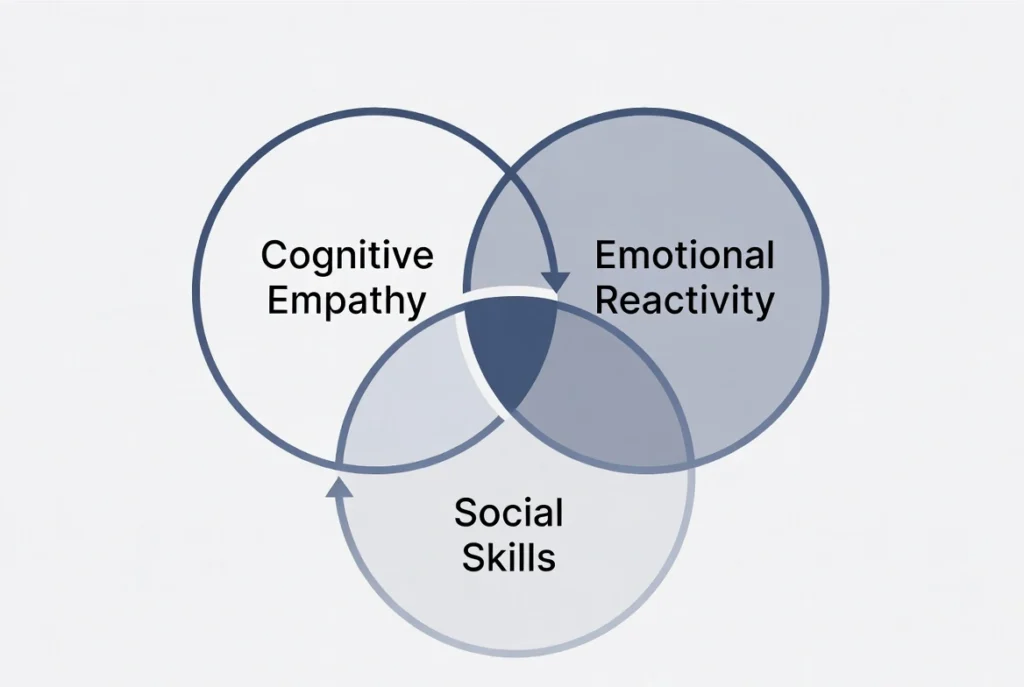
2. The 3-Factor Model
Factor analysis of the EQ suggests it measures three distinct dimensions:
Cognitive Empathy: Decoding perspective.
Emotional Reactivity: The visceral response.
Social Skills: The behavioral application of the first two.
3. Validity & Reliability
Why should a skeptic trust this? The EQ demonstrates high internal consistency (Cronbach’s alpha > 0.90) and high test-retest reliability. It is a stable measure that consistently differentiates between clinical populations (such as ASD) and neurotypical controls, validating its role as a robust psychometric tool.
Section II: Understanding the Scoring (The “Black Box” Revealed)
The EQ uses a 4-point Likert scale (strongly agree to strongly disagree). The maximum score is 80. But what do the numbers actually mean?
How the EQ Scoring Works (0-80 Scale)
The Norms
Based on large-scale population studies:
Average for Men: Approximately 42/80
Average for Women: Approximately 47/80
The slight statistical variance between sexes is a subject of intense debate but is consistently observed in data, likely due to a mix of biological and socialization factors.
The Clinical Cutoff
A score of 30 or below is often used as a clinical threshold. While this can be one of the signs of low emotional intelligence, it is not a diagnostic verdict of Autism Spectrum Disorder (ASD). It simply indicates a significantly lower-than-average drive to empathize, which may stem from various factors, including Alexithymia (difficulty identifying one’s own emotions).
The “Filler Items”
If you take the full version, you will notice questions that seem irrelevant to empathy (e.g., about hobbies or organization). These are control questions designed to prevent “response bias”—the tendency for a test-taker to answer in a way that makes them look good. They ensure the data is clean.
Section III: The EQ Profile Matrix (The Differentiator)
Most people stop at the total score. This is a mistake. Two people can score a “40” but have completely different psychological profiles.
Beyond the Total Score: Your Empathy Profile
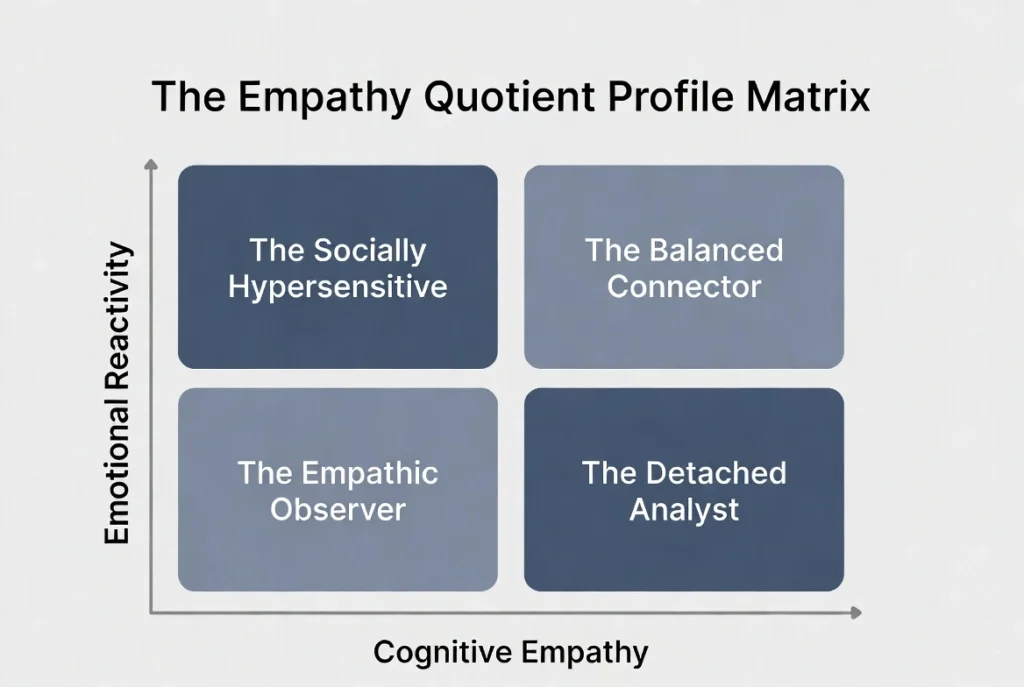
By analyzing your responses to specific sub-factors, we can map your “Empathy Profile.”
X-Axis: Cognitive Empathy (Low to High)
Y-Axis: Emotional Reactivity (Low to High)
Quadrants labeled as described below.
1. The Detached Analyst (High Cognitive / Low Emotional)
You understand exactly why someone is crying, but you don’t feel it yourself. You are excellent at crisis management and negotiation because you remain objective. However, you may be perceived as cold.
Growth Area: Developing social skills training to communicate warmth even if you don’t feel it viscerally.
2. The Socially Hypersensitive (Low Cognitive / High Emotional)
You “absorb” the emotions of the room like a sponge, but you often misinterpret why people are feeling that way. You may project your own feelings onto others.
Growth Area: Reality testing and perspective-taking to ensure your strong feelings align with the facts.
3. The Balanced Connector (High Cognitive / High Emotional)
You can accurately read the room and respond with appropriate emotion. This is the ideal state for the components of emotional intelligence to function in harmony.
Section IV: Critique & Nuance (For the Skeptic)
No psychometric tool is perfect. For the data-driven achiever, it is vital to understand the limitations.
The “Double Empathy Problem”
Recent research challenges the idea that low EQ scores automatically mean “social deficits.” The Double Empathy Problem suggests that communication breakdowns often happen because of a mismatch between two different neurotypes (e.g., an Autistic person and a neurotypical person), rather than a deficit in just one.
Does Low EQ Mean No Empathy?
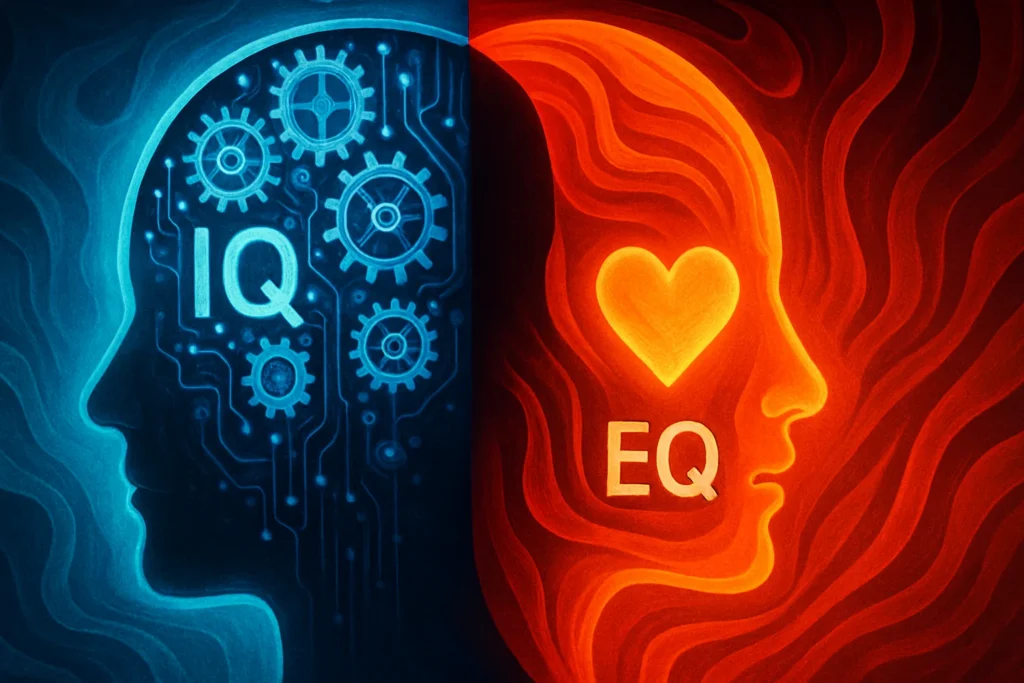
No. Someone might have a low EQ score but high compassion. They might struggle to read the cues (Cognitive) but care deeply once the situation is explained. This distinction is crucial when comparing emotional intelligence vs IQ. The former measures social attunement; the latter measures processing speed and logic. They are independent variables.
Section V: Actionable Development
Is your EQ score fixed at birth? The science of neuroplasticity says no. While there is a genetic component, empathy is largely a “use-it-or-lose-it” neural pathway.
Can You Raise Your Empathy Quotient?
Yes, through targeted intervention. The approach depends on which part of your profile (Cognitive or Emotional) needs strengthening.
1. For Lower Cognitive Empathy: Drill the Mechanics
If you struggle to “read” people, you need data.
Active Listening: Stop guessing. Use active listening exercises to verify your assumptions. Ask, “It sounds like you’re feeling frustrated because of X. Is that right?”
Fiction Reading: Studies show that reading literary fiction improves Theory of Mind by forcing the brain to simulate complex social worlds.
2. For Lower Emotional Reactivity: Somatic Awareness
If you struggle to “feel” with others, you may be disconnected from your own body.
Somatic Mindfulness: Use emotional self-regulation techniques to tune into your own physical sensations. You cannot resonate with another person’s joy or pain if you cannot identify it in your own physiology.
3. The Global Fix: Curiosity
The root of how to develop empathy skills is shifting from judgment (“That makes no sense”) to curiosity (“I wonder why they see it that way”).
Conclusion: Empathy is the Currency of Connection
The Empathy Quotient is not a report card on your humanity. It is a diagnostic tool—a baseline metric.
Whether you are a “Detached Analyst” or a “Socially Hypersensitive” leader, understanding your score allows you to compensate for your blind spots and leverage your strengths. In a world increasingly run by algorithms, your ability to connect with the human element is your ultimate competitive advantage.
Want a broader assessment of your leadership capabilities? While the EQ focuses specifically on empathy, ouremotional intelligence test free covers regulation, motivation, and social skills for a complete 360-view of your potential.
We use cookies to ensure that we give you the best experience on our website. If you continue to use this site we will assume that you are happy with it.