
Introduction: The Operating System You Never Learned to Use
Let me be direct with you: Most of what you think you know about communication in relationships is wrong.
You’ve been told to “communicate more.” To “be honest.” To “express your feelings.” These platitudes are worse than useless—they’re actively harmful because they create the illusion of guidance while offering nothing actionable.
Here’s the truth that changes everything: Communication isn’t just talking. It’s the operating system running beneath every relationship you’ll ever have. And like any operating system, it can be debugged, upgraded, and optimized—if you understand how it actually works.
The stakes are existential. The Harvard Study of Adult Development, which has tracked participants for over 85 years, reached a conclusion that should stop you cold: The quality of your relationships is the single strongest predictor of your health, happiness, and longevity. Not your career success. Not your bank account. Not your genetic inheritance. Relationships.
Poor communication doesn’t just create awkward dinners. It literally shortens your life.
But here’s what the research reveals that most people miss: Communication patterns and relationship satisfaction exist in what researchers call a “covariation” relationship. The ALT-SR model (Affective-Level Theories of Social Relations) demonstrates that negative communication and declining satisfaction don’t just correlate—they move together in real-time.
This means something profound: You don’t have to wait for your relationship to improve before your communication gets better. The arrow points both ways. Change how you communicate today, and you change the trajectory of your relationship immediately.
This guide gives you the complete system: the science of why we fail, the tools to communicate effectively, frameworks for navigating conflict, and practices for building lasting connection. No fluff. No platitudes. Just what works.
Let’s begin.
Section I: The Foundation — Why We Fail
Before we can build effective communication, we need to understand what destroys it. The patterns that erode relationships aren’t random—they’re predictable, identifiable, and correctable. But only if you can see them clearly.
The Hidden Barriers to Connection
Most people believe their communication problems are unique. They’re not. Decades of research have revealed that relationship-destroying communication follows remarkably consistent patterns across cultures, age groups, and relationship types.
Understanding these patterns is the first step to breaking them.
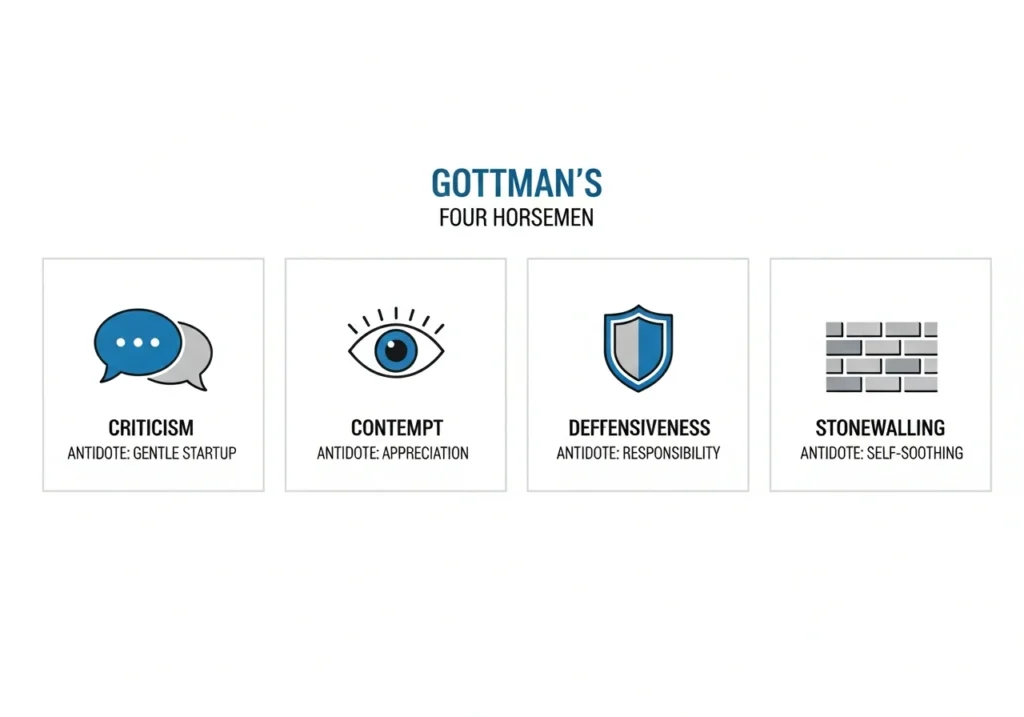
The Four Horsemen of the Apocalypse: Gottman’s Predictors of Relationship Death
Dr. John Gottman spent over four decades at the University of Washington’s “Love Lab,” studying thousands of couples with scientific precision. His team could watch couples interact for just 15 minutes and predict with 94% accuracy whether they’d divorce within six years.
How? By identifying four toxic communication patterns so destructive he named them after the biblical harbingers of the apocalypse:
HORSEMAN #1: CRITICISM
What it looks like: Attacking your partner’s character or personality rather than addressing a specific behavior.
The difference:
- Complaint (healthy): “I was worried when you didn’t call. I felt forgotten.”
- Criticism (toxic): “You never think about anyone but yourself. You’re so selfish.”
Criticism uses words like “always,” “never,” and “you are.” It globalizes the problem from a specific incident to a fundamental flaw in who your partner is.
Why it’s destructive: Criticism frames your partner as defective. It doesn’t invite problem-solving—it invites defensiveness. When someone feels their core identity is under attack, their higher brain functions literally shut down.
The Antidote — Gentle Startup:
Express your need without attacking their character. Use the formula: “I feel [emotion] about [specific situation]. I need [concrete request].”
Instead of: “You’re so inconsiderate. You never help around here.”
Try: “I feel overwhelmed when I come home to dishes in the sink. I need us to figure out a system that works for both of us.”
HORSEMAN #2: CONTEMPT
What it looks like: Expressions of disgust, superiority, or disrespect. Eye-rolling, sneering, mockery, name-calling, sarcasm dripping with hostility.
Examples:
- “Oh, you actually managed to take out the trash? Should I throw you a parade?”
- “You’re too stupid to understand what I’m saying.”
- [Eye roll] “Whatever.”
Why it’s the most dangerous: Contempt is the single greatest predictor of divorce. It communicates: “You are beneath me. You disgust me. You are worthless.”
Gottman’s research found that couples with high levels of contempt have weakened immune systems—they literally get sick more often. Contempt is psychological poison.
Contempt doesn’t emerge overnight. It’s the accumulated result of negative thoughts about your partner left to fester over time. Every time you catalog their flaws without addressing issues directly, you add to a reservoir of resentment that eventually overflows as contempt.
The Antidote — Building a Culture of Appreciation:
Combat contempt by actively building respect. Daily, notice what your partner does well. Express appreciation out loud, specifically. Keep a mental (or written) list of their positive qualities and return to it when frustration mounts.
Research shows that admiration and respect are the foundations that make contempt impossible. You cannot feel disgusted by someone you genuinely appreciate.
HORSEMAN #3: DEFENSIVENESS
What it looks like: Responding to complaints by counter-attacking, making excuses, or playing the victim—rather than taking any responsibility.
Examples:
- Partner: “You forgot to pick up the kids again.”
- Defensive response: “Well, if you hadn’t made me run all those errands this morning, I would have had time. Besides, you forget things too.”
Defensiveness says: “The problem isn’t me—it’s you” or “I’m actually the victim here.” It deflects rather than engages.
Why it’s destructive: Defensiveness blocks problem-solving completely. When both partners are defending their position rather than addressing the issue, conflicts escalate and repeat infinitely.
Defensiveness also invalidates your partner’s experience. When they raise a concern and you immediately counter-attack, you’ve told them their perception doesn’t matter. Over time, they stop bringing up concerns at all—which looks like peace but is actually withdrawal.
The Antidote — Taking Responsibility:
Accept some part of the complaint, even if you feel the criticism is mostly unfair. You don’t have to accept 100% responsibility—just find the kernel of truth you can own.
Instead of: “That’s not fair! I’m busy too!”
Try: “You’re right, I did forget. I’ve been overwhelmed, but that’s not an excuse. What can I do to make this right?”
This doesn’t mean becoming a doormat. It means being secure enough to acknowledge imperfection without feeling your entire worth is threatened.
HORSEMAN #4: STONEWALLING
What it looks like: Withdrawing from interaction completely. Shutting down, going silent, physically leaving, becoming unresponsive. The “thousand-yard stare.”
Why it happens: Stonewalling is usually not a power play—it’s a physiological response. The stonewaller’s nervous system has become so flooded with stress hormones that they literally cannot process information or respond coherently. Their body has entered “survival mode.”
Why it’s destructive: To the partner being stonewalled, it feels like abandonment. Like they’re talking to a wall. Like they don’t matter. Stonewalling communicates: “You’re not worth responding to.”
The stonewaller, meanwhile, may feel they’re preventing escalation by withdrawing. They’re not wrong about their state—but the impact on the relationship is severe.
The Antidote — Physiological Self-Soothing:
Learn to recognize when you’re becoming flooded (heart racing, muscle tension, tunnel vision) and call for a structured break.
Critical: This requires a specific protocol:
- Say explicitly: “I’m feeling flooded and need to take a break to calm down. Can we continue this in [specific time]?”
- Actually take 20+ minutes. Research shows it takes at least 20 minutes for stress hormones to clear enough for productive conversation.
- During the break, do something truly calming—not rehearsing your arguments or ruminating. Walk, breathe deeply, listen to music.
- Return and re-engage as promised.
Emotional Flooding: The Physiology of Shutdown
Understanding the Four Horsemen requires understanding the biological mechanism that drives stonewalling and makes all the Horsemen more likely: emotional flooding.
What happens in your body:
When you perceive a threat—and your partner’s criticism can absolutely register as a threat—your sympathetic nervous system activates. Your body doesn’t distinguish between a lion attack and a marital argument; it triggers the same ancient survival response:
- Heart rate spikes above 100 BPM (sometimes to 150+)
- Stress hormones (cortisol, adrenaline) flood your bloodstream
- Blood flow shifts away from your prefrontal cortex (rational thinking) toward your limbs (fight or flight)
- Your peripheral vision narrows
- You lose access to nuance, creativity, and empathy
In this state, productive communication becomes neurologically impossible. You’re operating from your amygdala, not your higher brain. You’ll say things you don’t mean, misinterpret neutral statements as attacks, and either explode (fight) or shut down (flight).
The flooding threshold varies:
- Some people flood quickly; others have higher tolerance
- History of trauma lowers the threshold
- Being tired, hungry, or stressed lowers the threshold
- Accumulated resentment lowers the threshold
The 20-minute rule:
Once you’ve flooded, research shows it takes a minimum of 20 minutes for your physiology to return to baseline—and that’s only if you’re actively calming yourself. If you’re mentally rehearsing the argument or fuming, you stay flooded.
This is why “Let’s just talk this through” after an escalation almost never works. Your biology won’t permit it.
Practical Protocol:
- Learn your early warning signs. For most people: tight chest, raised voice, inability to track what partner is saying, thoughts of “I can’t take this.”
- Agree in advance on a pause signal. Something like “I need to take 20” that both partners agree to respect without taking personally.
- Use the break for genuine self-soothing. Options that work:
- Walk (movement helps metabolize stress hormones)
- Deep breathing (activates parasympathetic nervous system)
- Listen to calming music
- Visualize a peaceful place
- Progressive muscle relaxation
- Do NOT: Rehearse arguments, check social media, complain to friends, drive aggressively, or anything that keeps you activated.
- Return to the conversation. The break is not avoidance—it’s preparation for productive engagement.
Miscalibrated Perceptions: The Danger of “Mind Reading” and Unspoken Expectations
Beyond the Four Horsemen lies another silent relationship killer: the assumption that you know what your partner thinks, feels, or should know—without ever checking.
Mind Reading:
Mind reading manifests in two equally destructive directions:
1. Assuming you know their intentions:
“You left the dishes because you don’t respect my time.”
“You didn’t text back because you’re mad at me.”
“You bought that without asking because you don’t think my opinion matters.”
The reality: You don’t know why they did what they did. You’re projecting a narrative onto ambiguous behavior—and it’s almost always more negative than the truth.
2. Assuming they should know your needs:
“If they really loved me, they’d know I need help right now.”
“I shouldn’t have to ask—it’s obvious.”
“They should just know this is important to me.”
The reality: Your partner is not a telepath. No matter how much they love you, they cannot reliably infer your needs, especially needs you’ve never articulated.
Why mind reading is so damaging:
- It substitutes assumption for inquiry
- It attributes negative intent where there may be none
- It creates conflicts about events that didn’t happen as perceived
- It makes your partner feel mischaracterized and defensive
- It absolves you of responsibility to communicate clearly
The unspoken expectations trap:
Everyone enters relationships with expectations—many inherited from family of origin, past relationships, or cultural scripts. When these expectations remain unspoken, they become landmines.
You expect your partner to prioritize your birthday; they didn’t grow up celebrating birthdays. Neither of you is wrong, but the unspoken expectation creates a perceived betrayal.
The antidote — Radical Inquiry:
Replace assumption with curiosity.
Instead of: “You’re obviously angry at me.”
Try: “I’m noticing you seem quiet. Is something on your mind?”
Instead of: “They should know I need support.”
Try: “I’m struggling right now. Can you sit with me for a few minutes?”
Make expectations explicit:
- What do you expect around finances, chores, family involvement, physical affection, holidays, careers?
- Where do those expectations come from?
- Have you actually communicated them, or just assumed they’re obvious?
The couples who thrive are not those who happen to share all expectations, but those who surface and negotiate expectations openly.
Section II: The Toolkit — Core Communication Skills
Understanding what breaks communication is necessary but insufficient. Now we build the skills that create connection. These aren’t abstract principles—they’re specific techniques you can practice and deploy.
Mastering the Mechanics of Dialogue
Effective communication is a skill set, not a personality trait. The following tools have been validated across decades of research in relationship science, clinical psychology, and conflict mediation.
Active Listening 2.0: Beyond Parroting with the LARA Method
You’ve heard of “active listening.” You’ve probably been told to nod, maintain eye contact, and repeat back what you heard. This basic version—let’s call it Active Listening 1.0—is a start, but it often devolves into mechanical parroting that feels patronizing.
“So what I’m hearing you say is that you’re frustrated?”
“Yes, that’s literally what I just said. Are you even listening?”
Active Listening 2.0 goes deeper. It’s not about performing listening—it’s about genuinely receiving and understanding your partner’s experience, then demonstrating that understanding in a way that creates connection.
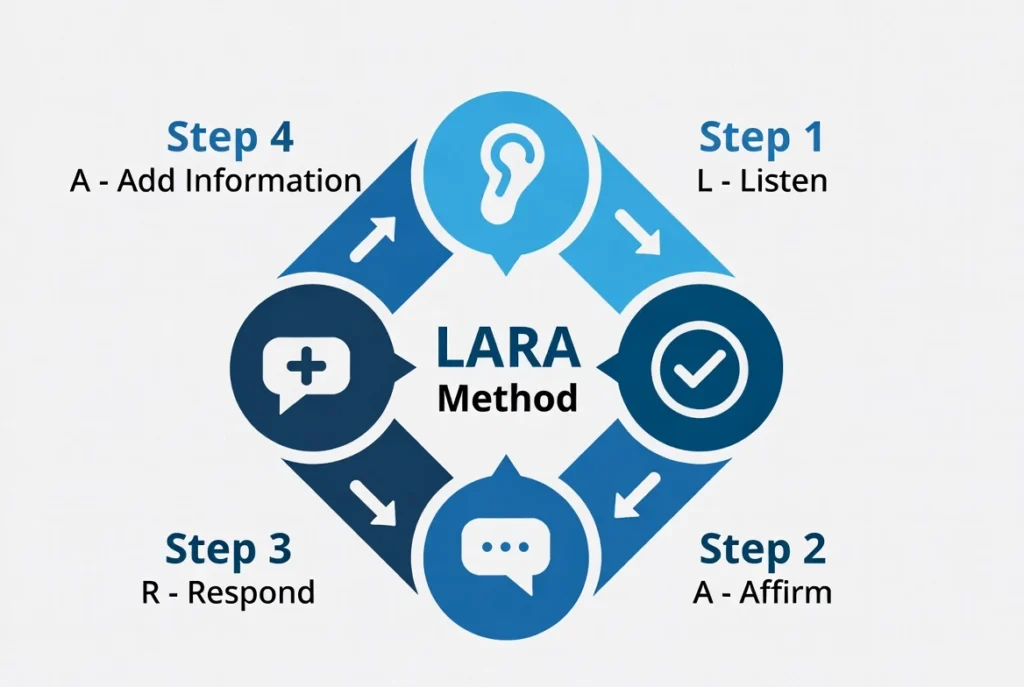
The LARA Method:
LARA is a framework developed for mediators and counselors that transforms active listening from technique into genuine dialogue.
L – LISTEN
Listening is not waiting for your turn to speak. It’s not preparing your rebuttal. It’s full-attention reception of what your partner is communicating—words, tone, body language, emotion beneath the words.
Practical steps:
- Physically orient toward your partner
- Put away distractions (phone face-down, TV off)
- Quiet your internal monologue
- Notice what they’re feeling, not just what they’re saying
- Let them complete their thoughts without interruption
A – AFFIRM
Affirm the legitimacy of their experience. This is not agreeing with their conclusions or accepting blame—it’s acknowledging that their feelings and perceptions are real and valid for them.
Affirming phrases:
- “That makes sense.”
- “I can see why you’d feel that way.”
- “That sounds really frustrating.”
- “Thank you for telling me this.”
The distinction: Validation isn’t agreement. You can affirm their experience while having a different perspective. “I understand you felt ignored—that wasn’t my intention, and I can see how my actions created that experience.”
R – RESPOND
Now you engage with the content—but from a place of having truly received it. Your response should demonstrate understanding before introducing your own perspective.
Effective responding:
- Reflect the core of what they communicated: “So the main thing is you felt like I wasn’t prioritizing us this week.”
- Ask clarifying questions: “Can you help me understand what that was like for you?”
- Share your perspective using I-statements (see next section)
A – ADD INFORMATION
Only after completing the first three steps do you add your own perspective, needs, or relevant information. Because you’ve demonstrated understanding, your partner is now actually capable of hearing you.
Effective adding:
- “From my side, what was happening was…”
- “Something I think we might both be experiencing is…”
- “What I need going forward is…”
Why LARA works:
Most conflict escalates because both parties are advocating their position while neither feels heard. LARA breaks the cycle by ensuring each person feels understood before moving to problem-solving.
When your partner feels genuinely heard, their nervous system calms, their defensiveness drops, and they become capable of hearing you in return.
For specific drills to develop this skill, see our active listening exercises guide.
The Art of the “I-Statement”: Expressing Needs Without Triggering Defensiveness
The single most practical tool for reducing conflict is learning to transform accusations into I-statements.
The problem with “You-Statements”:
Most complaints come out as “you” statements:
- “You never help with the kids.”
- “You make me feel unimportant.”
- “You always prioritize your friends over me.”
“You” statements trigger defensiveness because they:
- Attribute fixed character flaws (“you never”)
- Assign blame and intent
- Position you as prosecutor, them as defendant
Even if your complaint is legitimate, delivering it as a “you” statement almost guarantees a defensive response—which escalates conflict and prevents resolution.
The I-Statement Formula:
“I feel [emotion] when [specific situation/behavior] because [underlying need/reason].”
Examples:
| You-Statement (Triggering) | I-Statement (Effective) |
|---|---|
| “You never listen to me.” | “I feel unheard when I’m talking and you’re looking at your phone because I need to know what I say matters to you.” |
| “You’re so irresponsible with money.” | “I feel anxious when we make large purchases without discussing them because I need us to be a team on financial decisions.” |
| “You always put your family first.” | “I feel secondary when holiday plans get decided without my input because I need to feel like we’re building our own family unit.” |
Key components:
1. Emotion (not accusation): Name the actual feeling. “I feel criticized” isn’t an emotion—it’s an accusation disguised as a feeling. “I feel hurt” or “I feel defensive” are emotions.
2. Specific situation: Describe the concrete behavior or situation, not a character trait. “When you interrupted me in front of your parents” rather than “When you disrespect me.”
3. Underlying need: This is the gold. Beneath every frustration is an unmet need—for respect, security, connection, autonomy, appreciation. Identifying the need transforms the conversation from blame to collaboration.
Why this works:
I-statements share your experience without forcing your partner into a defensive posture. They create an opening for empathy rather than a demand for capitulation.
Your partner can’t argue with your feelings. They can argue about whether they “always” do something, but they can’t argue about whether you felt hurt.
Advanced application:
Combine I-statements with a request:
“I feel disconnected when we don’t have time to talk at the end of the day because I need to feel like we’re still a team. Could we try putting phones away during dinner?”
For more on this framework, see our nonviolent communication summary—NVC is built on this same foundation of observations, feelings, needs, and requests.
Nonverbal Communication: The Silent Conversation
Dr. Albert Mehrabian’s research suggested that in emotional communications, only 7% of meaning comes from words, while 38% comes from vocal elements and 55% from body language. While the exact percentages are context-dependent, the principle stands: your body is always communicating.
The congruence problem:
When your words and body language contradict each other, people believe the body. If you say “I’m not angry” through clenched teeth with crossed arms and a tight jaw, the message received is: angry.
Incongruence creates distrust. The listener senses something is “off” even if they can’t articulate what. Over time, this erodes confidence in the speaker’s authenticity.
Key nonverbal channels:
Facial expressions:
- The face reveals the seven universal emotions: happiness, sadness, fear, anger, surprise, disgust, contempt
- Microexpressions (1/25th second) reveal concealed feelings
- Eye-rolling is a primary contempt signal—one of the most damaging nonverbal behaviors
Eye contact:
- Sustained eye contact signals engagement and confidence
- Avoidance signals discomfort, shame, or deception
- Too much unbroken eye contact can feel aggressive
- During conflict, softening your gaze reduces threat perception
Body positioning:
- Open posture (uncrossed arms and legs) signals receptivity
- Turning toward your partner signals engagement
- Turning away or angling toward the exit signals desire to escape
- Leaning in signals interest; leaning back signals evaluation or withdrawal
Touch:
- Appropriate touch during conflict (hand on arm, hand-holding) reduces physiological arousal
- Absence of touch in relationships is a significant warning sign
- Touch must match the emotional need—sometimes space is needed
Vocal paralanguage:
- Tone, pace, volume, pitch communicate attitude
- Speaking slowly and softly de-escalates
- Rising pitch at end of statements signals uncertainty
- Sighing, scoffing, and dismissive sounds communicate contempt
Improving your nonverbal communication:
- Record yourself. Watch a video of yourself in conversation. Your body language patterns will become immediately obvious.
- Check congruence. Before difficult conversations, ask: Does my body match my intention? If you want to resolve conflict but your body is armored and tense, address that first.
- Mirror consciously. Subtly matching your partner’s posture and rhythm creates rapport. This should feel natural, not mimicry.
- Create physical safety. During hard conversations, position yourselves side by side (as if facing a shared problem) rather than face to face (as if opposing).
For deeper techniques, see our body language reading guide.
Open-Ended Questions: The Key That Unlocks Conversation
There’s a simple technique that transforms superficial exchanges into meaningful conversations: replacing closed questions with open ones.
Closed questions can be answered in one word:
- “Did you have a good day?” → “Fine.”
- “Are you upset?” → “No.”
- “Do you want to talk about it?” → “Not really.”
Open-ended questions require elaboration:
- “What was the best part of your day?”
- “What’s on your mind?”
- “How are you feeling about everything that happened?”
The power differential:
Open-ended questions signal genuine curiosity. They create space for the other person to take the conversation wherever they need it to go. They communicate: “I want to understand your full experience.”
Closed questions, especially in sensitive conversations, often feel like interrogation or attempts to control the narrative. They communicate: “Just give me the information I’m looking for.”
Effective open-ended stems:
- “What was that like for you?”
- “How did that affect you?”
- “What do you need right now?”
- “Tell me more about…”
- “What would it look like if this were resolved?”
- “What matters most to you about this?”
When closed questions are appropriate:
Closed questions aren’t always wrong. They’re useful for:
- Confirming specific facts
- Making logistics decisions
- Checking in briefly when deep conversation isn’t possible
But if you notice your conversations feeling shallow or your partner giving one-word answers, audit your question types.
Section III: Navigating Conflict — The Crucible
Conflict isn’t the enemy of relationships—it’s the crucible. How you handle friction determines whether your relationship stagnates, deteriorates, or deepens.
The goal isn’t to avoid conflict. It’s to develop conflict competence: the ability to navigate disagreements in ways that resolve issues and strengthen bonds.
Turning Friction into Intimacy
Research consistently shows that it’s not the presence of conflict but the handling of conflict that determines relationship outcomes. Happy couples aren’t conflict-free—they’ve mastered the ability to fight productively.
The “Repair Attempt”: The Secret Weapon of Happy Couples
If Dr. Gottman could identify one skill that separates thriving couples from struggling ones, it’s this: the ability to make and receive repair attempts.
What is a repair attempt?
A repair attempt is any statement or action that prevents negativity from escalating out of control. It’s a bid to break the cycle of attack and defend, to de-escalate tension, to signal “we’re on the same team even in this disagreement.”
Examples of repair attempts:
Verbal:
- “Can we take a break and try this again?”
- “I’m sorry, that came out wrong.”
- “I know I’m getting defensive. Give me a second.”
- “We’re getting off track. What are we really trying to solve?”
- “I love you, even though I’m frustrated right now.”
- Using a funny inside joke or nickname
Nonverbal:
- Reaching for their hand
- Softening your facial expression
- Taking a deep breath and visibly relaxing your body
- Moving from across the room to sit beside them
- A gentle smile
The critical variable:
The magic isn’t just in making repair attempts—it’s in receiving them. In struggling relationships, repair attempts get rejected, ignored, or met with renewed attack.
“Don’t try to change the subject.”
“You always do this.”
“[Ignoring the olive branch and continuing the attack]”
In thriving relationships, repair attempts get accepted, even imperfectly.
“Okay, let’s take a break. I love you too. Let’s talk in 20 minutes.”
“You’re right, we’re getting off track. The real issue is…”
“[Accepting the hand, squeezing it, taking a breath]”
How to build repair attempt capacity:
- Create a shared vocabulary. Agree on words, phrases, or signals that mean “I’m trying to repair.” Some couples use code words or silly signals that lighten the mood.
- Practice accepting repairs. Even when you’re still upset, recognize that your partner’s repair attempt is a gift. Receive it. You can continue the conversation with less intensity.
- Lower the bar. A repair attempt doesn’t have to be perfect. “I’m screwing this up” is a repair attempt. Receive it.
- Make repairs early. The sooner you attempt repair, the easier it is. Once you’ve been fighting for 45 minutes, both nervous systems are flooded and repairs bounce off.
The research is clear: The presence and acceptance of repair attempts is one of the strongest predictors of relationship stability. This skill is learnable—and it’s one of the highest-leverage interventions you can make.
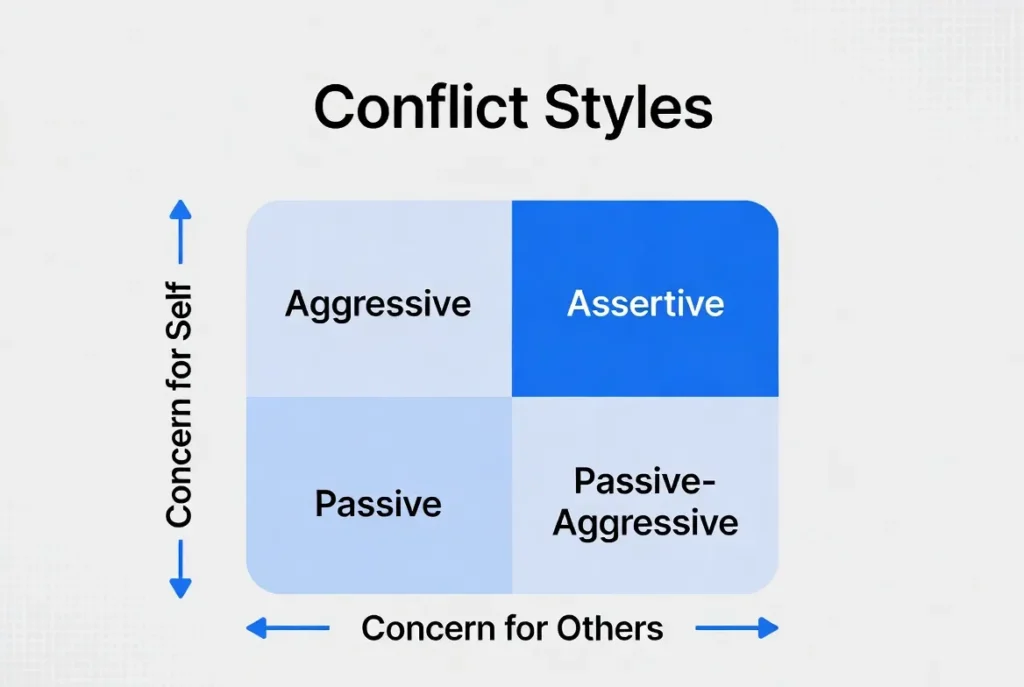
Conflict Styles: Identifying Passive, Aggressive, Passive-Aggressive, and Assertive Patterns
Everyone develops habitual responses to conflict, often rooted in childhood and family of origin. Understanding your default pattern—and your partner’s—is essential for growth.
THE FOUR CONFLICT STYLES:
1. Passive
Pattern: Avoiding conflict at all costs. Failing to express needs, opinions, or boundaries. Saying yes when you mean no. Allowing violations of your rights without protest.
Inner experience: “My needs don’t matter.” “It’s not worth fighting about.” “If I just keep the peace, everything will be fine.”
Impact on relationships: Short-term, it reduces friction. Long-term, it breeds resentment, creates power imbalances, and deprives your partner of knowing the real you. Passive communicators often “explode” periodically when the suppressed needs become unbearable.
What it looks like:
- Not expressing preferences
- Excessive apologizing
- Allowing interruptions without objection
- Going along to get along
- Saying “I don’t care” or “Whatever you want”
2. Aggressive
Pattern: Expressing your needs at the expense of others. Dominating, attacking, blaming, intimidating. Winning the argument regardless of the damage.
Inner experience: “I have to fight for what I need.” “Attack is the best defense.” “If I don’t dominate, I’ll be dominated.”
Impact on relationships: Creates fear and resentment. Partners withdraw, become passive, or become aggressive in return. Win-lose conflicts create lose-lose relationships.
What it looks like:
- Yelling, threatening, intimidating
- Interrupting constantly
- Name-calling and personal attacks
- Refusing to acknowledge partner’s perspective
- Using “you always” and “you never”
3. Passive-Aggressive
Pattern: Indirectly expressing aggression while maintaining a passive surface. Sarcasm, silent treatment, deliberate inefficiency, backhanded compliance.
Inner experience: “I can’t express anger directly, but I can make them pay.” “If I pretend to comply but subtly sabotage, I maintain control.”
Impact on relationships: Creates confusion and distrust. Partners sense hostility but can’t address it because it’s denied. Gaslighting-adjacent: “What? I didn’t do anything. You’re overreacting.”
What it looks like:
- Saying “fine” when clearly not fine
- Silent treatment / stonewalling
- Sarcasm with a smile
- “Forgetting” commitments repeatedly
- Complaining to others but never addressing directly
- Backhanded compliments
4. Assertive
Pattern: Expressing your needs, opinions, and boundaries clearly and directly while respecting the other person’s rights and dignity. Honest without being brutal. Firm without being hostile.
Inner experience: “My needs matter and so do theirs.” “We can find solutions that work for both of us.” “I can be honest without being cruel.”
Impact on relationships: Creates safety, trust, and authentic connection. Issues get addressed before they fester. Both partners feel heard and respected.
What it looks like:
- I-statements expressing feelings and needs
- Clear, specific requests
- Listening fully before responding
- Taking responsibility for your part
- Maintaining calm tone while being direct
- Setting boundaries without attacking
Identifying your pattern:
- What did conflict look like in your family of origin?
- When you imagine confronting someone, what do you feel? (fear = passive pattern; anger = aggressive pattern)
- What feedback have you received about how you handle disagreements?
- Does your style change depending on the context or person?
The goal: Move toward assertiveness regardless of your default. This requires passive people to build courage and aggressive people to build restraint. Both are possible.
For scripts and practice scenarios, see our assertive communication techniques guide.
How to Have Difficult Conversations: A Framework for High-Stakes Discussions
Some conversations are so loaded that they require preparation and structure: addressing a betrayal, raising a fundamental concern, negotiating a major life decision, revisiting old wounds.
The book Difficult Conversations from the Harvard Negotiation Project reveals that every difficult conversation is actually three simultaneous conversations:
1. The “What Happened” Conversation
This is about facts, interpretations, and blame. Each party has a different story about what happened and why.
The trap: Assuming your story is right and complete. Assuming you know the other person’s intentions.
The shift: Move from certainty to curiosity. Accept that there are always two (or more) legitimate perspectives. Their story isn’t wrong—it’s incomplete, just like yours.
2. The Feelings Conversation
Difficult conversations are never just about facts—they’re about emotions. Hurt, fear, anger, shame, guilt often drive the conflict but remain unspoken.
The trap: Pretending emotions aren’t relevant or trying to logic your way through.
The shift: Name and address emotions directly. “I think part of what makes this hard is that we’re both feeling hurt and unheard. Can we acknowledge that?”
3. The Identity Conversation
This is the internal conversation about what this situation says about who you are. Am I competent? Am I a good person? Am I worthy of love?
The trap: All-or-nothing thinking. If you made a mistake, you must be a bad person. If they’re criticizing you, your entire identity is threatened.
The shift: Embrace complexity. You can be a good person who made a mistake. You can be competent in general and have failed in this instance. You can be worthy of love and have behaved badly.
The Difficult Conversations Framework:
Before the conversation:
- Clarify your purpose. What do you actually want to achieve? (Often it’s understanding, not “winning.”)
- Untangle intent from impact. Their impact on you and their intent may be very different.
- Examine your contribution. It’s almost never 100% their fault.
- Anticipate the three conversations—for you and for them.
Starting the conversation:
- Begin from the “third story”—a neutral description both parties could agree with. Not “You’ve been neglecting our relationship” but “We’ve both been feeling disconnected lately.”
- State your purpose: “I want to understand your perspective and share mine so we can figure out how to move forward together.”
- Invite their perspective first. This signals genuine interest and often reveals information that changes your understanding.
During the conversation:
- Listen using LARA (Listen, Affirm, Respond, Add).
- Use I-statements when sharing your perspective.
- Make repair attempts when things escalate.
- Take breaks if either person floods.
Closing the conversation:
- Summarize what you’ve heard and what you’ve agreed to.
- Make specific, actionable commitments.
- Schedule a follow-up to check on progress.
For detailed scripts and examples, see our guide on how to have difficult conversations.
Setting Boundaries: Protecting Yourself Without Damaging the Relationship
Boundaries are often misunderstood. They’re not ultimatums, punishments, or attempts to control others. They’re clarifications of where you end and others begin.
What boundaries actually are:
A boundary is a statement of what you will or won’t do, what you will or won’t accept. It’s about your behavior and choices, not controlling theirs.
Not a boundary: “You need to stop talking to your ex.”
Boundary: “I’m not comfortable with the current level of contact with your ex. I need us to discuss what feels okay for both of us, or I’ll need to reconsider this relationship.”
See the difference? The first tries to control them. The second states your limit and what you’ll do if it’s crossed.
Why boundaries are necessary:
Without boundaries, you lose yourself. You become an extension of others’ needs. Resentment builds because you’re giving more than you can sustain.
Paradoxically, boundaries actually improve relationships. They create:
- Clarity about expectations
- Safety through predictability
- Respect through self-respect
- Sustainability through balance
Types of boundaries:
- Physical: Personal space, privacy, touch
- Emotional: What emotional labor you will/won’t provide; protection from emotional dumping
- Time: How you allocate your hours and attention
- Mental: Your right to your own thoughts, values, and opinions
- Material: Your possessions, money, resources
The boundary-setting process:
- Identify the violation. What specific behavior crosses your line?
- Clarify your need. What boundary needs to exist?
- Communicate clearly and directly. No hints, no hedging. State the boundary simply.
- State the consequence. What will you do if the boundary is crossed? (Not what you’ll do to them—what you’ll do.)
- Follow through. A boundary without enforcement isn’t a boundary—it’s a suggestion.
Example:
“I’m not available to discuss my mother after 9 PM. I need that time to decompress. If the topic comes up after 9, I’ll say ‘Let’s table this for tomorrow’ and I’ll stick to that even if you want to keep going.”
When boundaries meet resistance:
People who benefited from your lack of boundaries will often push back when you establish them. This doesn’t mean your boundaries are wrong—it may mean they were long overdue.
Hold firm. The discomfort of establishing boundaries is temporary. The resentment of never having them is chronic.
For workplace applications of the same principles, see our guide on setting boundaries in professional and personal contexts.
Section IV: Nurturing the Bond — Positive Communication
Avoiding negative patterns is necessary but not sufficient. Thriving relationships require the active cultivation of positive interaction, appreciation, and responsive engagement.
Beyond Conflict: Building a Culture of Appreciation
The absence of conflict is not the presence of connection. Many relationships have learned to avoid fighting through distance—separate lives, separate interests, cordial but superficial interaction. These relationships look stable but are often starving.
Positive communication isn’t the absence of negative. It’s the active presence of appreciation, engagement, and joy.
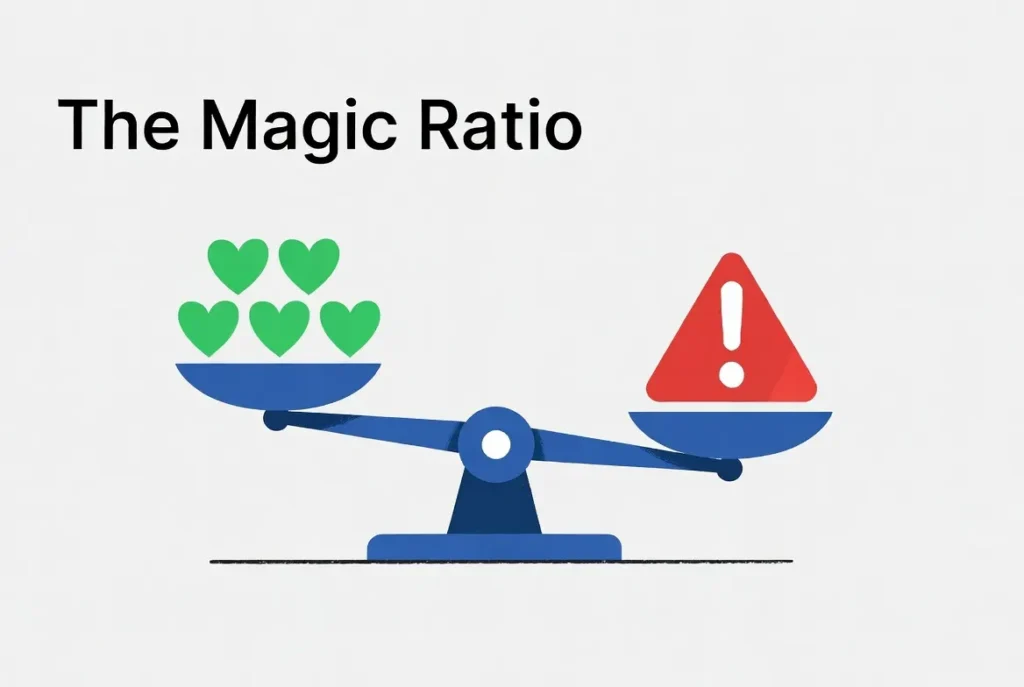
The Magic Ratio (5:1): The Mathematics of Relationship Success
Gottman’s research identified a critical threshold: stable, happy relationships maintain at least 5 positive interactions for every 1 negative interaction.
Not 1:1. Not 2:1. Five to one.
What counts as positive:
- Showing interest and asking questions
- Being affectionate (verbal and physical)
- Showing you care through small acts
- Intentional appreciation and compliments
- Finding opportunities for agreement
- Showing empathy and understanding
- Using humor and play
- Responding with joy to partner’s good news
What counts as negative:
- The Four Horsemen (criticism, contempt, defensiveness, stonewalling)
- Dismissing or ignoring partner’s emotions
- Failing to respond to bids for connection
- Being distracted when partner is sharing
- Turning away (physically or emotionally) during interaction
The ratio math:
If you had one critical argument this week, you need approximately five distinct positive interactions to balance it. Not five nice words—five separate positive moments.
If contempt appeared (eye-roll, sneer, mockery), the damage is even greater. Some researchers suggest contempt requires a 20:1 ratio to repair.
Practical application:
- Audit your ratio. For one day, track your positive and negative interactions with your partner. Where does the ratio actually stand?
- Build in positivity rituals:
- Greet each other with genuine warmth (not just “hey”)
- Express one specific appreciation daily
- Physical affection without agenda
- Intentional interest in their day/projects/thoughts
- Reduce the negatives. Each Horseman you eliminate dramatically improves your ratio. You don’t need to be perfect—you need to be above 5:1.
Active-Constructive Responding: How You Celebrate Matters More Than How You Console
Dr. Shelly Gable’s research revealed something surprising: How you respond to your partner’s good news predicts relationship health more reliably than how you respond to their bad news.
When your partner shares positive news (“I got the promotion!” or “My mom’s health results came back good!”), your response falls into one of four categories:
ACTIVE-CONSTRUCTIVE (The only good one)
What it looks like:
Enthusiastic, engaged support. Asking questions, celebrating, helping them relive the positive experience.
Example:
Partner: “I got the promotion!”
Response: “That’s amazing! I knew they’d recognize your work. Tell me everything—how did they tell you? What did they say? How are you feeling? We have to celebrate!”
Impact: Partner feels supported, valued, seen. The joy is amplified.
PASSIVE-CONSTRUCTIVE (Quietly positive but disengaged)
What it looks like:
Positive but understated, without real engagement.
Example:
Partner: “I got the promotion!”
Response: “That’s great, honey.” [Returns to phone/TV/task]
Impact: Partner feels their news isn’t important enough to warrant real engagement. Joy is dampened.
ACTIVE-DESTRUCTIVE (Pointing out downsides)
What it looks like:
Highlighting potential negatives, questioning whether it’s really good news, making it about problems.
Example:
Partner: “I got the promotion!”
Response: “Does that mean you’ll be working more hours? Will you get to keep your current team? What about the stress—you know how you get when you’re overwhelmed.”
Impact: Partner feels criticized and unsupported. Joy is stolen.
PASSIVE-DESTRUCTIVE (Ignoring the news)
What it looks like:
Changing the subject or not acknowledging the news at all.
Example:
Partner: “I got the promotion!”
Response: “Did you remember to pick up the dry cleaning?”
Impact: Partner feels invisible. Joy is erased.
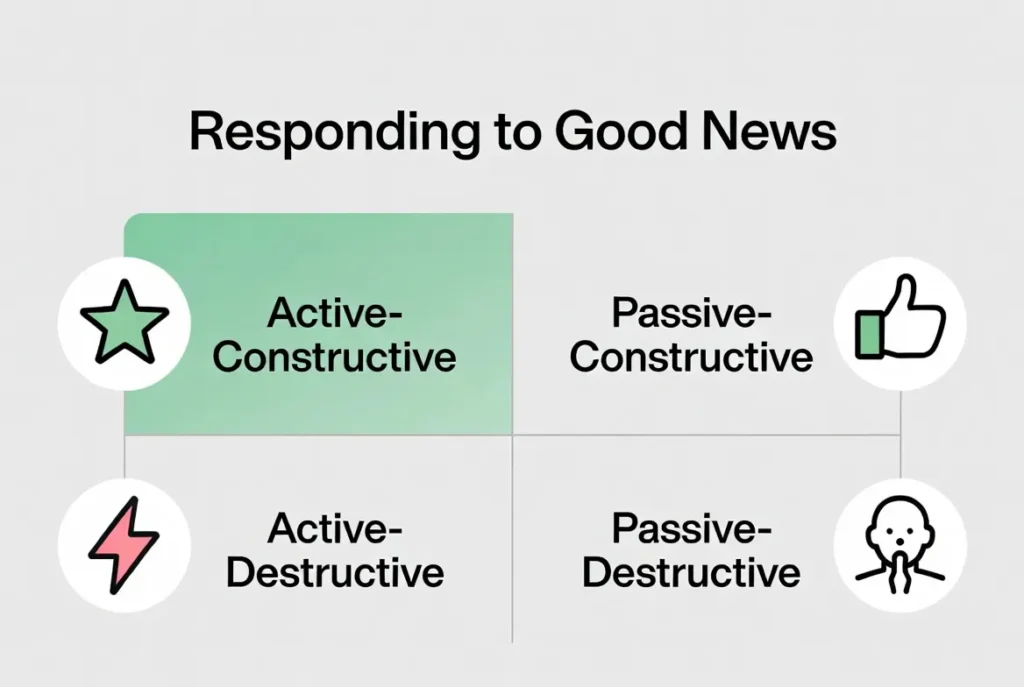
The insight: Active-constructive responding is about presence and enthusiasm, not grand gestures. It’s about stopping what you’re doing, making eye contact, and genuinely engaging with their joy.
Many partners who would never deliberately hurt each other are habitually passive-constructive—positive but disengaged. This slow withdrawal creates distance over time.
Practice this week: The next time your partner shares positive news, practice a fully active-constructive response. Stop. Engage. Ask questions. Celebrate.
Bids for Connection: The Small Moments That Build (or Erode) Your Relationship
Gottman’s research identified a concept that explains how relationships actually work day-to-day: bids for connection.
What is a bid?
A bid is any attempt to get your partner’s attention, affection, humor, support, or engagement. Bids can be verbal, physical, or behavioral:
- “Look at this sunset” (bid for shared experience)
- “How was your meeting?” (bid for engagement)
- Reaching for their hand (bid for physical connection)
- Sighing loudly (bid for attention/support)
- “You won’t believe what happened today” (bid for interest)
- Sending a meme or link (bid for shared humor)
Bids are often small and easy to miss. They don’t announce themselves.
Responding to bids: Three options
1. Turning Toward
Acknowledging and engaging with the bid.
Example: “Look at this sunset” → “Wow, you’re right, those colors are beautiful.”
2. Turning Away
Missing or ignoring the bid (often unintentionally).
Example: “Look at this sunset” → [Continues scrolling phone, doesn’t respond]
3. Turning Against
Rejecting the bid with hostility or irritation.
Example: “Look at this sunset” → “I’m busy. Not everything is a photo opportunity.”
The research findings:
- Couples who divorced within six years turned toward bids 33% of the time
- Couples who stayed together turned toward bids 86% of the time
That’s it. The couples who lasted responded to the small moments. The couples who didn’t, didn’t.
Why this matters:
Every bid is an opportunity to build trust and connection or to erode it. No single ignored bid destroys a relationship—but thousands of turned-away moments accumulate into emotional distance.
Your partner stops making bids because experience has taught them the bids won’t land. That quiet resignation looks like peace. It’s actually slow-motion relationship death.
Application:
- Notice bids. Start observing the small attempts your partner makes to connect. They’re probably more frequent than you realize.
- Turn toward. Even briefly. Even if you’re busy. “That sounds interesting—can you tell me about it in 10 minutes when I finish this?”
- Make your own bids. Don’t wait for your partner to initiate all connection.
The 5 Love Languages: Speaking in the Right Currency
Dr. Gary Chapman’s framework, while less rigorously scientific than Gottman’s, provides a useful mental model: people give and receive love in different “languages,” and mismatches create disconnection even when both partners have good intentions.
The Five Love Languages:
- Words of Affirmation: Verbal expressions of love, appreciation, and encouragement. Compliments, “I love you,” words of support.
- Quality Time: Undivided attention. Focused presence. Doing things together without distractions.
- Receiving Gifts: Thoughtful tokens that show you were thinking of them. Not about material value—about the thought and effort.
- Acts of Service: Actions that help or make life easier. Doing chores, running errands, taking tasks off their plate.
- Physical Touch: Physical affection. Hugging, holding hands, cuddling, sex, casual touch.
The mismatch problem:
We tend to express love in our own primary language and expect our partner to speak the same one.
Someone whose primary language is Acts of Service might show love by handling household tasks—and feel unloved because their partner (whose language is Words of Affirmation) never comments on these efforts.
Meanwhile, the Words partner is constantly verbally affirming (in their own language) and feeling rejected because their Acts-of-Service partner doesn’t seem to notice or reciprocate with words.
Both are giving love. Neither feels loved.
Practical application:
- Identify your own primary and secondary languages
- Identify your partner’s primary and secondary languages (ask—don’t assume)
- Make conscious effort to express love in their language, not yours
- Tell your partner what makes you feel most loved (be specific)
Limitation of the model: Don’t use love languages to excuse failure in other areas. “Physical touch isn’t my language” doesn’t exempt you from physical affection if your partner needs it. All five languages matter to some degree; primacy just means emphasis.
For relationship-specific exercises integrating these concepts, see our communication exercises for couples guide.
Section V: Context & Application — Real-World Deployment
Frameworks are only valuable when applied. This section grounds everything in practical reality: how to implement these skills in romantic relationships, professional settings, and how to recognize when professional help is needed.
Applying These Skills in Real Life
Theory without action is entertainment. Let’s get practical.
In Romantic Relationships: The “State of the Union” Meeting
One of the most effective interventions for couples is shockingly simple: schedule a regular, structured conversation about the relationship itself.
Various relationship experts call this different things—the “State of the Union,” “Bae Sesh,” “Marriage Meeting,” or “Weekly Review.” The name doesn’t matter. The structure does.
Why this works:
Most couples only discuss relationship issues when problems become unbearable—when emotions are high, defenses are up, and flooding is imminent. This is the worst possible time for productive conversation.
A scheduled meeting creates a designated container for:
- Addressing small issues before they become big ones
- Expressing appreciations and strengthening positive connection
- Coordinating on practical matters
- Discussing needs, desires, and dreams
The structure:
1. Appreciations (5-10 minutes)
Each person shares 3-5 specific appreciations from the past week.
- “I appreciated when you made coffee Tuesday morning without being asked.”
- “I felt really supported when you listened to me vent about work on Wednesday.”
This starts the meeting on a positive note and maintains the 5:1 ratio.
2. Logistics & Coordination (5-10 minutes)
Calendar review, upcoming events, practical coordination.
Get this handled efficiently so it doesn’t bleed into intimate time.
3. Challenges & Issues (15-20 minutes)
Each person can raise one issue to discuss. Use the frameworks:
- I-statements for sharing concerns
- LARA for listening
- Repair attempts if things escalate
- Focus on understanding before problem-solving
4. Dreams & Goals (5-10 minutes)
Check in on individual and shared goals.
- How can I support your growth this week?
- What are we building together?
Implementation tips:
- Schedule it. Put it on the calendar like any other important meeting.
- Protect it. Don’t cancel for convenience.
- Time-box issues. If one issue is taking too long, agree to continue it next week or schedule a separate conversation.
- Make it pleasant. Have it over a nice meal or with a glass of wine. Create positive associations.
- Both parties can add agenda items. This prevents one person from always being the one raising issues.
This single practice can transform relationships that have fallen into roommate mode or chronic unaddressed tension.
In the Workplace: Radical Candor and Professional Communication
The same communication principles apply at work—with important calibrations for professional context.
Radical Candor:
Kim Scott’s framework provides a useful model for professional feedback:
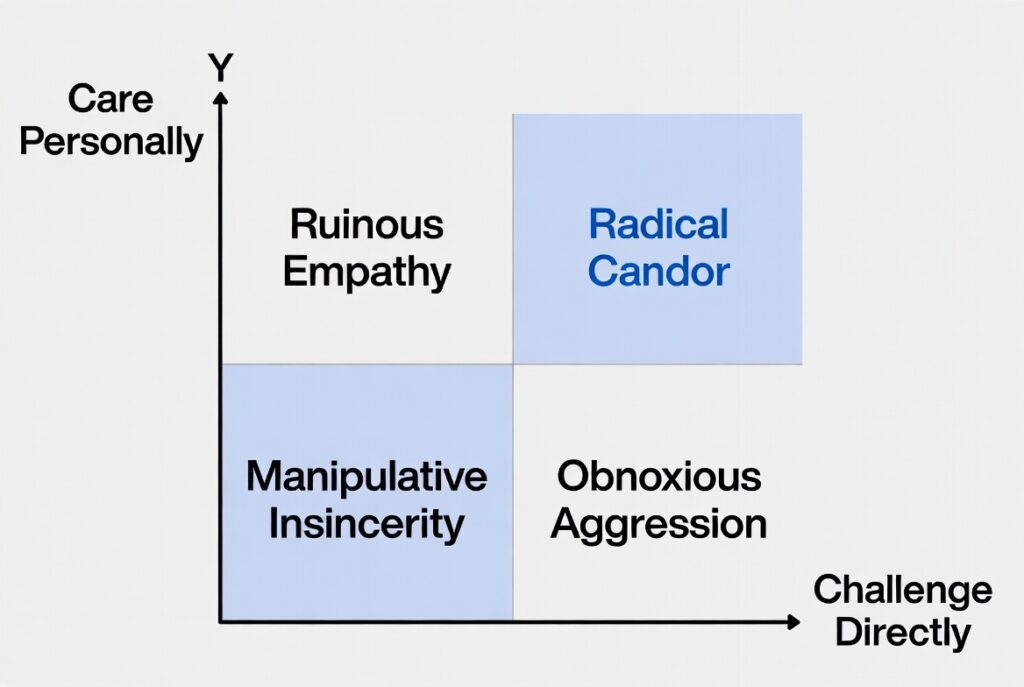
- Radical Candor: Care personally AND challenge directly. Honest feedback delivered with genuine regard for the person.
- Obnoxious Aggression: Challenge without caring. Brutal, harsh feedback without relationship foundation.
- Ruinous Empathy: Care without challenging. Being “nice” at the expense of honest feedback that could help them grow.
- Manipulative Insincerity: Neither caring nor challenging. Passive-aggressive, political, avoidant.
Professional application of relationship skills:
- Active listening is just as critical in work meetings as in personal relationships. People notice when you’re actually tracking versus waiting to talk.
- I-statements work for professional feedback: “I was concerned when the deadline was missed because the client relationship depends on reliability” rather than “You’re unreliable.”
- Repair attempts apply in team conflict. “I think we’re getting off track here. What’s the core issue we’re actually trying to solve?”
- Bids for connection exist at work too. Colleagues who turn toward casual bids (“Did you see the game?”) build relationship capital that makes collaboration smoother.
- Conflict styles manifest identically in professional settings. Passive employees get overlooked. Aggressive employees create toxic environments. Assertive employees build respect and get results.
For specific workplace scenarios, see our radical candor examples guide and our resources on conflict resolution strategies for professional contexts.
Emotional Intelligence in Professional Relationships:
The concept of emotional intelligence—self-awareness, self-regulation, motivation, empathy, and social skills—applies equally to marriages and boardrooms. The ability to read emotional dynamics, manage your own reactions, and navigate relationships skillfully is a career accelerator.
For deeper exploration, see our guide on emotional intelligence in marriage and how the same principles apply professionally.
When to Seek Professional Help
These frameworks are powerful. They are not therapy. Some situations require professional intervention.
Signs you need couples therapy:
- The same conflicts repeat indefinitely without resolution or growth
- Contempt has become the norm, not the exception
- One or both partners has mentally checked out—emotional divorce before legal divorce
- There’s been a major betrayal (affair, serious deception) that you can’t process alone
- Communication attempts escalate rather than resolve—every conversation becomes a fight
- You’re staying for logistics (kids, finances) but the relationship feels dead
- Abuse is present—verbal, emotional, physical, or sexual (Note: Individual safety comes first; some situations require individual therapy and/or separation before couples work)
What good couples therapy provides:
- A neutral third party who can see patterns you can’t
- Structured practice of skills in a safe environment
- Tools tailored to your specific dynamic
- Accountability for follow-through
- Processing of past wounds that are affecting the present
What couples therapy isn’t:
- A referee to declare who’s “right”
- A quick fix (meaningful change takes months, not sessions)
- Effective if only one partner is committed
- A substitute for doing the work between sessions
Finding the right therapist:
- Look for training in evidence-based approaches (Gottman Method, EFT, etc.)
- Interview multiple therapists before committing
- Both partners should feel safe with the therapist
- The therapist should challenge both of you, not take sides
Don’t wait too long. Research shows couples wait an average of six years after problems start before seeking help. By then, resentment has calcified and repair is exponentially harder. Early intervention is far more effective.
Conclusion: Communication as a Lifelong Practice
You’ve now been through more than 8,000 words of frameworks, research, and practical tools. The temptation is to feel like you “know” this material.
You don’t. Not yet.
Communication is a practice, not a trait. Knowing about the Four Horsemen doesn’t mean you won’t fall into criticism under stress. Understanding LARA doesn’t mean you’ll naturally listen well when triggered. Reading about repair attempts doesn’t mean you’ll make them when flooded.
The gap between knowing and doing is bridged by practice—awkward, imperfect, consistent practice.
Your action plan:
This week:
- Identify your most common Horseman (criticism? defensiveness? stonewalling?) and catch yourself each time it appears.
- Make one intentional active-constructive response to your partner’s good news.
- Turn toward one bid for connection you might normally miss.
This month:
- Schedule your first “State of the Union” meeting with your partner.
- Practice I-statements in at least one difficult conversation.
- Have one conversation about communication itself—what’s working, what isn’t.
This quarter:
- Address one long-avoided difficult conversation using the framework.
- Establish one new boundary you’ve been neglecting.
- Assess whether professional help might accelerate your growth.
The compound effect:
Relationships that last aren’t built on grand gestures. They’re built on thousands of small moments—bids answered, repairs offered, appreciations expressed, conflicts navigated. Each positive interaction compounds. Each Four Horsemen encounter corrected builds capacity for the next challenge.
The couples who thrive at 70 aren’t the couples who started with perfect compatibility. They’re the couples who practiced getting better, decade after decade.
Start today. Start small. Start now.
Continue Your Learning
Core Skills:
Conflict & Boundaries:
- [Nonviolent Communication Summary]
- [How to Have Difficult Conversations]
- [Setting Boundaries]
- [Conflict Resolution Strategies]
Relationship-Specific:
- [Communication Exercises for Couples]
- [Emotional Intelligence in Marriage]
Professional Application:
[Radical Candor Examples]