
Introduction: Why Most Self-Improvement Advice Fails (And What Actually Works)
Here’s an uncomfortable truth: you’ve probably consumed more personal development content in the past year than your grandparents did in their entire lives. Podcasts during your commute. Articles bookmarked but never finished. Books stacked on your nightstand, gathering dust.
Yet somehow, you’re still reading another guide.
The question isn’t whether personal development works—it demonstrably does. The question is why the gap between consuming advice and actually transforming your life feels wider than ever.
The answer lies in understanding what personal development truly is—and more importantly, what it isn’t.
Personal development is the deliberate, systematic improvement of your knowledge, capabilities, character, and life circumstances through conscious self-effort. It encompasses three interconnected dimensions: Body (physical capacity and energy), Mind (cognitive abilities, skills, and knowledge), and Soul (purpose, values, and emotional well-being).
Unlike the quick-fix promises that dominate social media, genuine personal development operates on a different timeline. Research from University College London suggests that forming new automatic behaviors takes an average of 66 days—not the mythical 21 days popular culture promotes. Real transformation requires patience, but it delivers something fleeting motivation never can: sustainable change that compounds over years.
The documented benefits are substantial:
- Enhanced psychological well-being through increased self-efficacy and internal locus of control
- Reduced chronic stress via improved coping mechanisms and emotional regulation
- Greater life satisfaction from alignment between daily actions and core values
- Improved professional outcomes including career advancement and earning potential
- Stronger relationships built on emotional intelligence and authentic communication
This guide is structured as a complete system, not a collection of tips:
Part I: The Foundation establishes the psychological prerequisites—self-awareness and mindset—without which all other efforts remain superficial.
Part II: The Method introduces the Personal Development Plan (PDP), a structured framework for translating abstract aspirations into concrete action.
Part III: Advanced Strategies explores the meta-skills of learning and mastery that accelerate your growth trajectory.
Part IV: Sustainability addresses the often-neglected question of how to maintain progress through habit formation and resilience.
Part V: Holistic Integration ensures your development creates a full life, not just a successful career.
Part VI: Optimization provides the accountability and review systems that prevent your plan from becoming another abandoned project.
Consider this your operating manual. Not for motivation, but for methodical transformation.
Section I: The Foundation (Self-Awareness & Mindset)
Before building anything meaningful, you need solid ground beneath your feet. In personal development, that foundation consists of two elements: understanding who you actually are (self-awareness) and believing you can become who you want to be (growth mindset).
Without these, you’re constructing on sand.
Step Zero: Stop Consuming, Start Acting
If you’ve read more than three personal development books in the past year but can’t identify specific, measurable ways your life has improved, you’re suffering from a modern affliction: consumption addiction disguised as growth.
This isn’t your fault. The content economy is designed to create consumers, not practitioners. Every article you read triggers a small dopamine release—the feeling of progress without the discomfort of actual change. You finish a book feeling inspired, then move on to the next one before implementing anything from the first.
The process must become your focus, not the fleeting sensation of motivation.
Motivation is a neurochemical state. It fluctuates based on sleep quality, blood sugar levels, and whether you argued with your partner this morning. Building your development strategy on motivation is like building a house on weather—sometimes it’s there, sometimes it isn’t.
Process, by contrast, is a system that operates regardless of how you feel. It’s the commitment to show up at your desk at 6 AM whether you’re inspired or exhausted. It’s the weekly review that happens every Sunday, regardless of how “productive” the week felt.
Your First Action: Deep Reflection
Before setting any goals or creating any plans, you must slow down to speed up. Counterintuitive as it sounds, the fastest route to transformation begins with stillness.
Schedule 90 uninterrupted minutes—no phone, no music, no other humans—and work through these questions in writing:
- What would I do differently if I knew I couldn’t fail? (This reveals desires you’ve suppressed due to fear.)
- What patterns keep repeating in my life that I wish would stop? (This reveals blind spots and unresolved issues.)
- When was the last time I felt completely aligned—where my actions matched my values? (This reveals your authentic self beneath social conditioning.)
- What am I pretending not to know? (This reveals the uncomfortable truths you’ve been avoiding.)
- If I continue on my current trajectory for five years, where will I actually end up? (This reveals the gap between your current path and your desired destination.)
The answers to these questions become the raw material for everything that follows. Don’t skip this step. Every ambitious person who stalls out in their development shares the same failure: they tried to optimize before they understood.
Cultivate a Growth Mindset: The Belief That Changes Everything
In the 1990s, Stanford psychologist Carol Dweck identified a variable that predicted success across domains more reliably than IQ, talent, or socioeconomic background: mindset.
Individuals with a fixed mindset believe that intelligence, talent, and personality are largely static. You’re either smart or you’re not. You’re either naturally athletic or you’re not. Failure proves you lack ability.
Individuals with a growth mindset believe that abilities are developed through dedication, effort, and strategic learning. Failure provides information about what needs improvement.
The neurological basis for this is now well-established. Neuroplasticity—the brain’s ability to form new neural connections throughout life—means that you can literally rewire your cognitive architecture through deliberate practice. The 40-year-old learning a new language is growing new neural pathways, just as the 10-year-old is.
This isn’t motivational rhetoric; it’s biology.
The Practical Difference
When facing a challenging project:
- Fixed mindset: “If I fail, it proves I’m not capable. Better to protect my ego by not trying fully.”
- Growth mindset: “This will stretch my current abilities. Whether I succeed or fail, I’ll be more capable afterward.”
When receiving critical feedback:
- Fixed mindset: “They’re attacking who I am. I need to defend myself or dismiss their opinion.”
- Growth mindset: “This is data about my blind spots. How can I extract the useful information?”
When observing someone more skilled:
- Fixed mindset: “They have something I don’t. Their success threatens my self-image.”
- Growth mindset: “They’ve put in work I haven’t. What can I learn from their approach?”
Growth Mindset Activities: Reframing Failure as Feedback
Your relationship with failure determines your growth ceiling. Here’s a systematic approach to rewiring it:
The Failure Reframe Exercise:
- Identify a recent failure or setback (a rejected proposal, a failed project, a relationship conflict).
- Write down your initial interpretation: “I failed because _______________.”
- Challenge the interpretation: “What else could explain this outcome?”
- Extract the data: “What specifically did this teach me about my skills, approach, or assumptions?”
- Create the action item: “Based on this learning, what will I do differently next time?”
- Complete the reframe: “I didn’t fail at ___. I discovered that ___ and will apply this by ___.”
Repeat this exercise weekly for three months. You’re not just changing how you think about failure—you’re building a neural pathway that automatically converts setbacks into growth opportunities.
Developing Self-Awareness: The Cornerstone of All Growth
Socrates summarized two thousand years of subsequent philosophy in two words: “Know thyself.”
Self-awareness is the meta-skill that enables all other development. You cannot fix what you cannot see. You cannot leverage strengths you haven’t identified. You cannot navigate toward your destination if you don’t know your starting coordinates.
Research from organizational psychologist Tasha Eurich reveals a sobering finding: 95% of people believe they’re self-aware, but only 10-15% actually are. The gap between self-perception and reality is not small—it’s enormous.
Self-awareness operates on two dimensions:
Internal Self-Awareness: How clearly you see your own values, passions, aspirations, reactions, and impact on others.
External Self-Awareness: How accurately you understand how others perceive you.
Both are necessary. Internal without external creates blind spots that damage relationships and career. External without internal creates chameleon behavior that erodes authenticity and well-being.
The “Five Whys” Method: Uncovering Deep Motivations
Surface-level goals often mask deeper needs that, once understood, transform your approach entirely.
The Process:
State a goal or desire you have.
Ask “Why is this important to me?” Answer honestly.
Ask “Why?” about that answer.
Repeat until you reach a core value or need (usually 4-5 levels).
Example:
- Goal: I want to earn $200,000 per year.
- Why? So I can afford a nicer house and car.
- Why? So people will respect me and see me as successful.
- Why? Because I felt invisible and undervalued growing up.
- Why? Because my parents were struggling financially and I associated that with being “less than.”
- Core Need: Recognition and worthiness.
This changes everything. If the core need is recognition, there are many paths to it—some healthier than others. The person who understands their core need can pursue it intentionally rather than hoping money will accidentally satisfy something it wasn’t designed to address.
Personal SWOT Analysis: Your Strategic Self-Assessment
Borrowed from business strategy, a Personal SWOT Analysis provides a structured framework for honest self-evaluation across four dimensions.
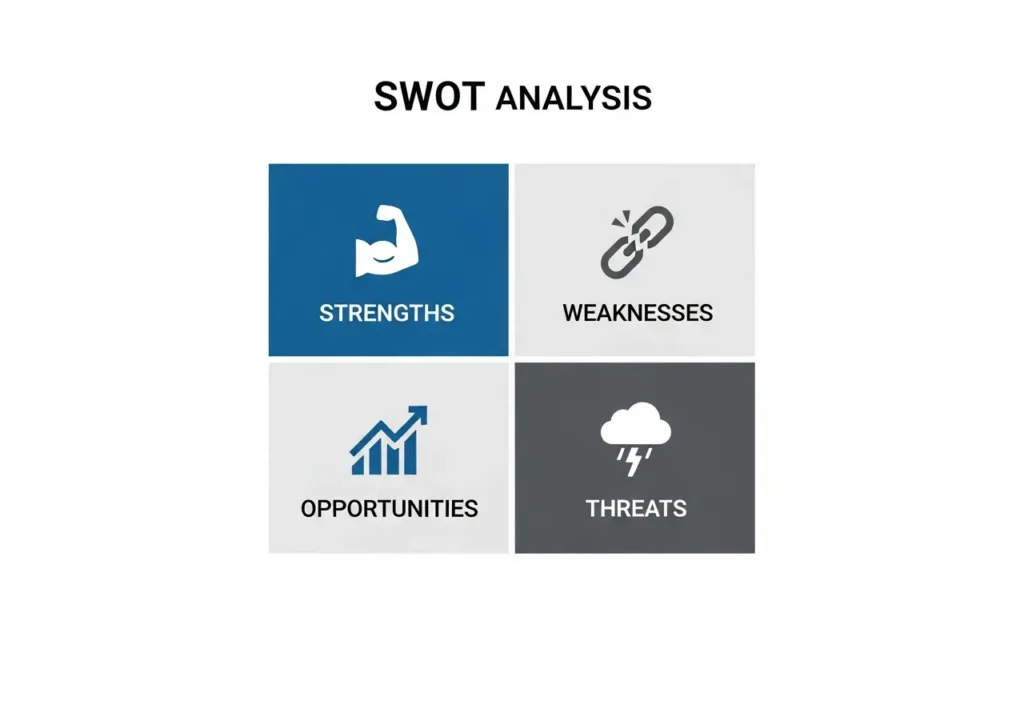
Conducting Your Personal SWOT Analysis:
Strengths (Internal – Positive)
What do you do better than most people in your field? What do others consistently compliment you on? What resources do you have access to (skills, networks, capital, energy)?
Weaknesses (Internal – Negative)
Where do you consistently underperform? What do you avoid because you know you’re not good at it? What feedback have you received repeatedly but not acted on?
Opportunities (External – Positive)
What trends in your industry or life stage could you leverage? What unmet needs exist that match your strengths? Who in your network could open doors if you asked?
Threats (External – Negative)
What changes in your industry could make your skills obsolete? What personal habits or circumstances could derail your progress? What are your competitors (for jobs, opportunities, or goals) doing that you’re not?
For detailed guidance on conducting this analysis effectively, including personal SWOT analysis examples across different career stages and life situations, see our dedicated resource.
The SWOT becomes the foundation for gap analysis—the distance between where you are and where you want to be. Every weakness that matters to your goals becomes a learning objective. Every strength becomes a lever to maximize. Every opportunity becomes a potential action. Every threat becomes a risk to mitigate.
Section II: Creating Your Structured Personal Development Plan (PDP)
Self-awareness without action is philosophy. Action without structure is chaos. A Personal Development Plan (PDP) is the bridge between knowing who you are and becoming who you want to be.
Think of your PDP as a strategic document for your life—updated regularly, specific enough to guide daily decisions, flexible enough to adapt as you evolve.
We offer a comprehensive personal development plan template as a free download at the end of this guide, but understanding the principles behind each section matters more than following a format mechanically.
Define Your Personal Vision & Aspirations
Before setting goals, you need a destination. Not a vague sense of wanting “more” or “better,” but a clear articulation of what a fully realized life looks like for you specifically.
This is your Personal Vision—the organizing principle that makes goal-setting meaningful rather than arbitrary.
Crafting Your Personal Vision Statement
A personal vision statement answers the question: “What kind of person do I want to be, and what kind of life do I want to create?”
It should be:
- Personal: Unique to you, not derived from social expectations
- Present-tense: Written as if you’re already living it
- Holistic: Encompassing career, relationships, health, contribution, and inner life
- Inspiring: Creates emotional resonance when you read it
- Guiding: Helps you make decisions about where to invest your limited time and energy
Example Personal Vision Statements:
“I am a leader who develops others’ potential while building organizations that solve meaningful problems. I prioritize presence with my family, continuous intellectual growth, and physical vitality. I approach challenges with curiosity rather than anxiety and contribute actively to my community.”
“I am a creator who brings new ideas into the world through writing that changes how people think. I cultivate deep friendships, maintain rigorous honesty in all relationships, and build financial security that enables freedom. I treat my body as the foundation for everything else.”
For more examples and a step-by-step crafting process, explore our personal vision statement examples resource.
Finding Your Ikigai: The Intersection of Purpose and Practicality
The Japanese concept of Ikigai offers a framework for finding purpose that balances idealism with pragmatism.

The Four Dimensions:
- What You Love (Passion): Activities that create flow states. Time disappears. You’d do them without external reward.
- What the World Needs (Mission): Problems that need solving. Gaps in the market or community. Contributions that would make the world better.
- What You Can Be Paid For (Profession): Skills the market values. Demand exists. Someone will exchange money for this.
- What You’re Good At (Vocation): Areas of competence or potential competence. Natural aptitudes and developed skills.
The intersections reveal important insights:
- Passion + Mission (but not paid or good at it) = Delight but not wealth
- Profession + Vocation (but no passion or mission) = Comfortable but empty
- Passion + Vocation (but no mission or payment) = Satisfaction but not impact
- Mission + Profession (but no passion or skill) = Uncertainty and frustration
True Ikigai exists where all four overlap.
For most people, this isn’t discovered through contemplation alone—it emerges through experimentation. You must test hypotheses about what you love, develop skills to discover what you’re good at, observe the market to understand what people pay for, and engage with the world to discover what it needs.
Download our Ikigai worksheet to systematically work through each dimension and identify potential areas of overlap in your life.
Set High-Level Goals: SMART vs. CLEAR Frameworks
With your vision articulated, goals become the milestones marking your progress toward that destination.
Two frameworks dominate modern goal-setting. Each has strengths; the choice depends on context.
SMART Goals (Best for Specific, Measurable Outcomes)
- Specific: Precise and unambiguous
- Measurable: Quantifiable progress indicators
- Achievable: Challenging but realistic
- Relevant: Aligned with your broader vision
- Time-bound: Clear deadline
Example: “Obtain my PMP certification by December 31st, 2025, by studying 10 hours per week and passing the exam on my first attempt.”
SMART goals work exceptionally well for:
- Career milestones with clear definitions
- Skill acquisition with measurable competency levels
- Health and fitness targets
- Financial objectives
CLEAR Goals (Best for Adaptive, Complex Environments)
- Collaborative: Involves others and builds relationships
- Limited: Constrained in scope and duration
- Emotional: Connects to intrinsic motivation
- Appreciable: Can be broken into smaller accomplishments
- Refinable: Allows for adjustment as you learn
Example: “Build a network of peers in my industry who I can learn from and collaborate with, starting with five meaningful connections this quarter.”
CLEAR goals work better for:
- Relationship and network development
- Creative projects where the final form isn’t clear
- Career transitions requiring exploration
- Personal growth areas that resist quantification
The Five-Year Horizon: Long-Term Vision with Flexibility
Long-term thinking provides direction; short-term action provides progress. The five-year time horizon balances these—long enough to envision significant transformation, short enough to feel tangible.
Your 5 year plan template should include:
Life Domains to Address:
- Career/Professional Development
- Financial Position
- Relationships and Family
- Health and Physical Vitality
- Personal Growth and Learning
- Contribution and Legacy
For Each Domain:
- Where do you want to be in five years? (Vision)
- What would need to be true by year three to be on track? (Milestone)
- What’s the first major step within the next twelve months? (Action)
The power of the five-year plan isn’t prediction—the future is inherently unpredictable. The power is direction. When you know where you’re heading, daily decisions become clearer. Should you take that lateral move or stay in your current role? Should you invest in that course or save the money? The five-year vision provides context for present-moment choices.
Optimizing Skill Acquisition: Hard Skills vs. Soft Skills
Your PDP must address both technical competencies and interpersonal capabilities.
Hard Skills are teachable, measurable abilities acquired through training, education, or experience. They’re typically job-specific and can be demonstrated through tests, portfolios, or certifications.
Examples: Data analysis, coding languages, financial modeling, project management methodologies, design software proficiency, language fluency.
Soft Skills are interpersonal and behavioral competencies that affect how you work and interact with others. They’re harder to measure but often more critical for leadership and career advancement.
Examples: Communication, emotional intelligence, conflict resolution, leadership, adaptability, creative problem-solving, time management.
For a comprehensive breakdown, see our hard skills vs soft skills list organized by industry and career level.
The Skill Gap Analysis
A skills gap analysis identifies the distance between your current capabilities and those required for your goals.
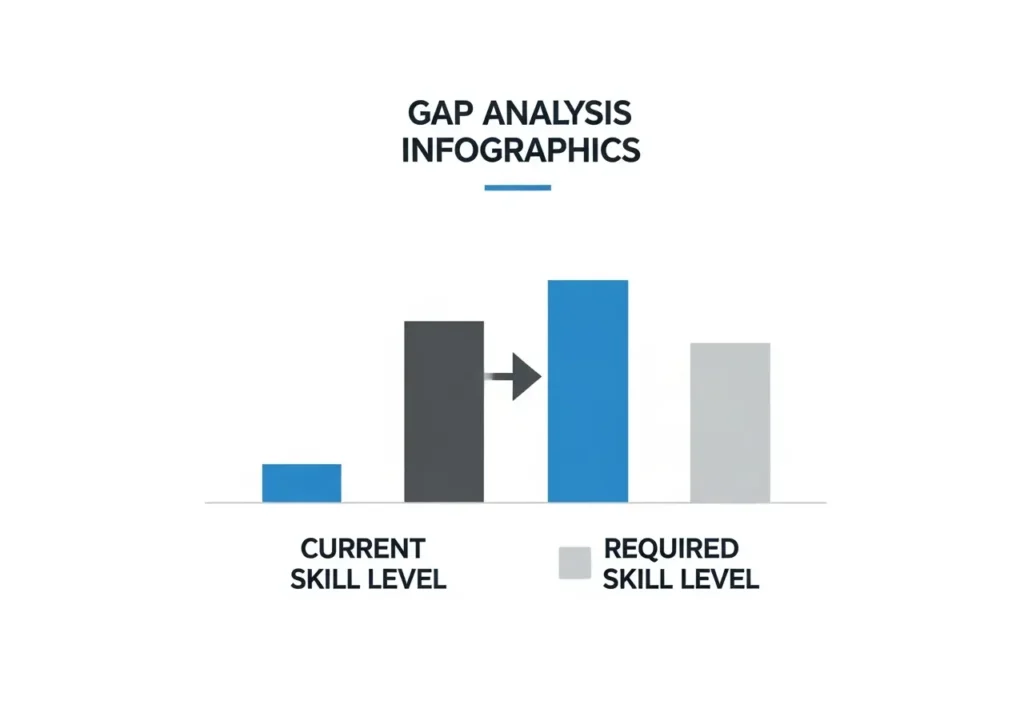
Process:
- List all skills relevant to your five-year vision and immediate next role
- Honestly assess your current level (1 = novice, 5 = expert)
- Determine the required level for your goal
- Calculate the gap
- Prioritize based on impact and urgency
- Identify development methods (courses, practice, mentorship, projects)
For a ready-to-use framework, download our skills gap analysis template.
Context-Specific PDPs:
Different contexts require adapted approaches:
For personal development plan examples for work, the focus shifts to competencies valued by your organization and industry. Your plan should align with performance review criteria and potential career paths within your company.
When identifying areas of improvement for employees, consider both performance feedback you’ve received and the capabilities demonstrated by successful people at the level you aspire to reach.
For those still in education, PDP for students examples emphasize foundational skills, exploration of interests, academic achievements, and early career preparation.
A career development plan specifically maps the skills, experiences, and relationships needed to progress in your chosen field. This differs from a general PDP in its narrow focus on professional advancement.
For those in management, a leadership development plan addresses the unique competencies required to lead others effectively: strategic thinking, people development, organizational influence, and results delivery through teams.
Section III: Advanced Learning & Mastery Strategies
Having a plan is necessary but insufficient. The speed at which you close skill gaps determines how quickly you reach your goals. This section covers the meta-skills of learning itself.
Focus on Systems, Not Just Goals
“You do not rise to the level of your goals. You fall to the level of your systems.” — James Clear
Goals determine direction. Systems determine progress.
A goal is a desired outcome: “I want to write a book.”
A system is a process that operates regularly: “I write 500 words every morning before checking email.”
The goal without the system is a wish. The system without the goal lacks direction. You need both, but if forced to choose, invest more attention in designing your systems.
System Design Principles:
- Make it automatic: The less decision-making required to execute, the more likely execution becomes. Decide once (I write at 6 AM in my home office using this software) rather than daily (Should I write today? When? Where?).
- Reduce friction: Every additional step between you and the behavior is a potential failure point. Want to read more? Keep a book on your pillow. Want to exercise in the morning? Sleep in your workout clothes.
- Create accountability: External commitment increases follow-through. Public declarations, accountability partners, coaches, or bet contracts with consequences all leverage social pressure productively.
- Build in feedback loops: Systems that provide regular data on their effectiveness allow for optimization. Track your key metrics and review them regularly.
- Design for bad days: Your system should be sustainable when motivation is low, energy is depleted, and life is chaotic. A system that only works under ideal conditions isn’t a system—it’s a fantasy.
Meta-Learning: How to Learn Faster
In a knowledge economy, learning velocity is a competitive advantage. Two evidence-based techniques dramatically improve how effectively you acquire and retain information.
Active Recall: Retrieving Rather Than Reviewing
Most people study by re-reading or highlighting. This feels productive but produces minimal retention because it’s passive—information washes over you without requiring mental effort.
Active recall forces your brain to retrieve information from memory, which strengthens the neural pathways associated with that information.
Application: Instead of re-reading notes, close them and write down everything you can remember. Use flashcards that require producing the answer, not recognizing it. After reading a chapter, summarize the key points from memory before looking back.
Spaced Repetition: Timing Your Reviews for Maximum Retention
The forgetting curve is steep—we lose most new information within days if we don’t actively reinforce it. Spaced repetition schedules reviews at increasing intervals (1 day, 3 days, 1 week, 2 weeks, 1 month) to catch information just before you would have forgotten it.
Application: Use spaced repetition software (Anki, SuperMemo, or similar) for factual information you need to retain. Schedule review sessions for skills and concepts at increasing intervals rather than cramming all practice into one period.
The Feynman Technique: Teaching to Learn
Named after physicist Richard Feynman, this technique exposes gaps in understanding that passive consumption hides.
The Process:
- Choose a concept you’re trying to understand
- Explain it as if teaching a 12-year-old—using simple language, no jargon
- Identify where your explanation breaks down or becomes vague
- Return to your sources to fill those gaps
- Repeat until you can explain it simply and completely
If you can’t explain something simply, you don’t understand it well enough. The act of translating complex ideas into simple language forces genuine comprehension.
The 70-20-10 Rule of Learning
Research on professional development consistently supports the 70-20-10 model for skill development:
70% Experience (Learning by Doing)
Most learning happens through challenging assignments, stretch projects, and on-the-job problem-solving. You cannot read your way to competence. At some point, you must do the thing to develop the skill.
Implication: Volunteer for challenging projects. Seek stretch assignments. Create opportunities for practice even when formal opportunities don’t exist.
20% Exposure (Learning from Others)
Mentors, peers, coaches, and networks accelerate learning by sharing their experience, providing feedback, and modeling effective approaches.
How to Find a Mentor:
- Identify people who have achieved what you’re pursuing
- Look for shared connections or communities
- Provide value before asking for anything
- Make a specific, low-commitment initial ask
- Be prepared to demonstrate commitment and coachability
- Formalize the relationship once rapport is established
For a detailed approach to building mentorship relationships, see our guide on how to find a mentor.
Additionally, 360 feedback questions—gathering input from supervisors, peers, and direct reports—provides a multi-perspective view of your strengths and development areas that self-assessment cannot replicate.
10% Education (Formal Learning)
Courses, books, certifications, and training programs provide foundational knowledge and frameworks. Essential but insufficient alone.
Setting Learning Goals:
Effective learning goals are specific about what capability you’ll develop, how you’ll develop it, and how you’ll know when you’ve succeeded.
For inspiration, explore our learning goals examples across different skill categories and career stages.
Section IV: Mastering Consistency (Habits & Resilience)
Motivation starts the journey. Habits continue it. Resilience maintains it when everything falls apart.
Building Lasting Habits
Habits are the compound interest of personal development. Small behaviors, repeated consistently, accumulate into transformed capabilities and circumstances.
Habit Stacking: The Power of Pairing
Rather than creating habits from scratch, attach new behaviors to existing routines.
Formula: “After I [CURRENT HABIT], I will [NEW HABIT].”
Examples:
- “After I pour my morning coffee, I will write my three priorities for the day.”
- “After I sit down at my desk, I will take three deep breaths before opening any applications.”
- “After I finish dinner, I will read for 20 minutes before any screen time.”
The existing habit serves as a trigger, reducing the cognitive load required to remember and initiate the new behavior.
The 1% Rule (Kaizen): Small Improvements, Massive Results
The Japanese concept of Kaizen emphasizes continuous small improvements over dramatic transformations.
Improving 1% daily results in being 37 times better over one year (1.01^365 = 37.78).
Application: Instead of “I will exercise for an hour daily” (which you’ll abandon by February), try “I will do one pushup after brushing my teeth” (which you’ll actually do). Once the minimal habit is established, gradual expansion becomes natural.
The Four Laws of Behavior Change:
(Adapted from James Clear’s framework)
- Make it obvious: Use implementation intentions (“I will [BEHAVIOR] at [TIME] in [LOCATION]”). Design your environment to surface cues for desired behaviors.
- Make it attractive: Pair habits with immediate rewards. Use temptation bundling (only listen to your favorite podcast while exercising).
- Make it easy: Reduce friction for good habits, increase friction for bad ones. The Two-Minute Rule: scale any habit down to two minutes or less to start.
- Make it satisfying: Track habits visually. Never miss twice—when you break the chain, restart immediately.
Developing Mental Resilience
Progress is never linear. Setbacks, failures, and unexpected obstacles are not aberrations—they’re inherent to any meaningful pursuit. Resilience determines whether you interpret these as reasons to quit or data to integrate.
The ABCDE Model for Cognitive Reframing
Developed by psychologist Albert Ellis and expanded by Martin Seligman, this model provides a systematic approach to processing adversity.
A – Adversity: What happened objectively? (Describe the event without interpretation.)
B – Beliefs: What did you tell yourself about what happened? (Capture your internal narrative.)
C – Consequences: What were the emotional and behavioral outcomes of those beliefs? (Notice how your interpretation affected your response.)
D – Disputation: Challenge the beliefs. Are they accurate? What evidence contradicts them? What’s a more realistic interpretation?
E – Energization: What are the emotional and behavioral outcomes of the new interpretation?
Example:
- A: My project proposal was rejected by leadership.
- B: “I’m not capable of contributing at this level. They probably think I’m not ready for advancement.”
- C: Felt dejected, avoided contributing ideas in subsequent meetings, considered job searching.
- D: “What evidence supports this interpretation? None—I received positive feedback overall. What’s more likely? The proposal didn’t fit current priorities, or I needed to present it differently. What can I learn? I should gather stakeholder input earlier in the process.”
- E: Disappointment but not devastation. Requested specific feedback. Applied learning to next proposal.
Building Grit: Growth Mindset Activities for Resilience
- Deliberate difficulty: Regularly take on challenges where failure is possible. Stretch projects, learning new skills, public speaking—anything that creates discomfort builds tolerance for it.
- Pre-mortem analysis: Before beginning a significant project, imagine it failed completely. List every possible reason why. Address preventable failures in advance and mentally prepare for unpreventable ones.
- Obstacle anticipation: For each major goal, list three realistic obstacles. For each obstacle, determine your response in advance. When obstacles arise, you’re prepared rather than surprised.
- Recovery rituals: Define in advance how you’ll process setbacks—journaling, exercise, conversation with a trusted person, or time-bounded rumination followed by decisive action.
Section V: Holistic Growth (The SPIRE Model)
Professional achievement without personal well-being is a hollow victory. The SPIRE model, developed by positive psychologist Tal Ben-Shahar, ensures your development creates a full life, not just an impressive résumé.
The SPIRE Model: Growth in Five Dimensions

Spiritual: Purpose and Meaning
Not necessarily religious—spiritual development concerns your sense of meaning, purpose, and connection to something larger than yourself.
Development Questions:
- What gives your life meaning beyond material success?
- What would you do if you knew you had only five healthy years remaining?
- When do you feel most connected to something larger than yourself?
Development Practices:
- Regular reflection on values and purpose (journaling, contemplation, discussion)
- Engagement with philosophy, wisdom traditions, or spiritual practices that resonate
- Contribution to causes beyond personal benefit
- Time in nature or activities that induce awe
Physical: The Foundation of Performance
Your body is the substrate upon which all other development depends. Chronic sleep deprivation, poor nutrition, and physical stagnation create cognitive impairment, emotional dysregulation, and reduced capacity for growth.
This isn’t about optimization for its own sake—it’s about having the energy and mental clarity to pursue everything else.
The Three Pillars:
Sleep:
- Adults need 7-9 hours per night (individual variation exists, but “I only need 5 hours” is almost always self-deception)
- Consistent sleep and wake times matter more than duration
- Sleep quality affects learning, emotional regulation, creativity, and decision-making
Nutrition:
- Eat mostly whole foods, including plenty of vegetables and adequate protein
- Minimize ultra-processed foods, excessive sugar, and inflammatory substances
- Hydration affects cognitive function more than most people realize
Movement:
- 150 minutes of moderate cardiovascular exercise per week is the baseline for health
- Resistance training preserves muscle mass, bone density, and metabolic health as you age
- Regular movement throughout the day matters as much as dedicated exercise sessions
Intellectual: Continuous Learning
Intellectual vitality comes from engagement with ideas, deliberate skill development, and the cultivation of expertise.
Development Questions:
- What are you learning right now that genuinely excites you?
- In what domains do you want to develop deeper expertise?
- How are you challenging your existing beliefs and mental models?
Development Practices:
- Dedicated learning time (reading, courses, deliberate practice)
- Engagement with ideas outside your professional domain
- Discussion and debate with people who think differently
- Teaching what you learn to solidify understanding
Relational: Connection and Community
Human well-being is fundamentally relational. Social isolation is as dangerous to health as smoking. Deep relationships require investment but return dividends in every other life domain.
The Wheel of Life Assessment often reveals that relationships are the most neglected domain for ambitious achievers. When you assess your satisfaction across life dimensions, relational fulfillment frequently lags behind career advancement.
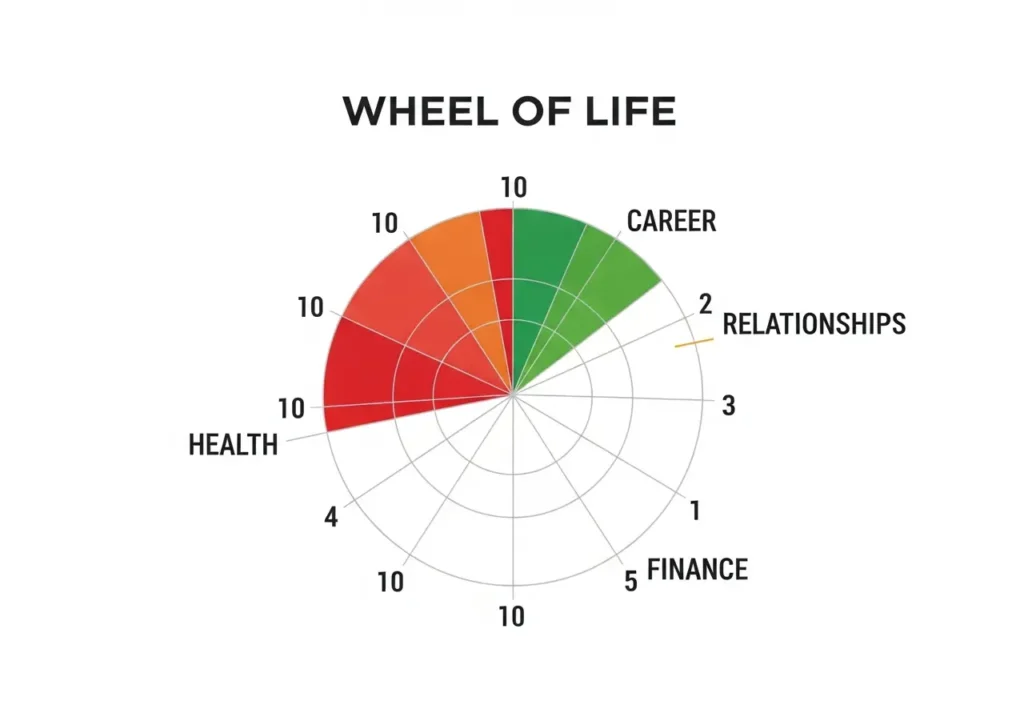
The Wheel of Life assessment provides a visual snapshot of life balance, revealing which domains are flourishing and which are neglected.
Building Your Support Network:
Mentors: People ahead of you on paths you want to walk. They provide guidance, shortcuts, and perspective from experience.
Peers: People at similar stages pursuing similar goals. They provide solidarity, feedback, and mutual accountability.
Supporters: People who believe in you regardless of outcomes. Family, friends, and partners who provide emotional foundation.
Emotional: Intelligence and Regulation
Emotional intelligence—the ability to perceive, understand, manage, and use emotions effectively—predicts life success more reliably than IQ beyond a moderate threshold.
The Four Components of Emotional Intelligence:
- Self-awareness: Recognizing your emotions as they occur and understanding their effects
- Self-management: Regulating emotional responses, adapting to circumstances, and channeling emotions productively
- Social awareness: Empathy, reading others’ emotional states, understanding social dynamics
- Relationship management: Influencing, coaching, managing conflict, building bonds, and collaborating effectively
Development Practices:
- Mindfulness meditation: Develops meta-awareness of emotional states, creating space between stimulus and response
- Emotional labeling: Naming emotions with precision (“I’m feeling anxious” vs. “I feel bad”) reduces their intensity and increases regulation
- Somatic awareness: Noticing how emotions manifest physically (chest tightness, jaw clenching) provides early warning for regulation
- Perspective-taking: Deliberately considering situations from others’ viewpoints develops empathy and reduces interpersonal conflict
Section VI: Optimization & Sustainability
A plan that isn’t reviewed becomes a forgotten document. Development that isn’t supported becomes an abandoned project. This section addresses the systems that keep your growth on track.
Accountability & Support Systems
Willpower is a limited resource. External accountability structures preserve willpower by making commitment social rather than purely personal.
The Accountability Partner Structure:
Find someone pursuing compatible goals (not necessarily identical). Establish regular check-ins (weekly works well). Share specific commitments and report on follow-through.
Effective Accountability Questions:
- What did you commit to last week?
- What did you actually accomplish?
- What got in the way of full execution?
- What are you committing to this week?
- How can I support you?
Professional Coaching:
For significant transitions or accelerated development, professional coaching provides structured accountability with expertise. Unlike mentoring (based on the mentor’s experience) or therapy (focused on healing), coaching focuses on closing the gap between where you are and where you want to be through structured conversation and accountability.
The 30-60-90 Day Plan for Transitions:
When entering a new role, relationship, or life stage, a 30 60 90 day plan for new job or situation provides structure during the critical early period when habits and impressions are formed.
- Days 1-30: Learn, observe, ask questions, understand context, build relationships
- Days 31-60: Contribute, propose improvements, execute on initial projects
- Days 61-90: Lead initiatives, demonstrate value, establish yourself as a contributor
This framework applies beyond new jobs—any significant transition benefits from structured phases of learning, contributing, and leading.
Tracking and The Weekly Review
The system that keeps everything connected is the regular review. Without it, plans drift, priorities blur, and weeks disappear without progress.
How to Review Your PDP: The Weekly Review Ritual
Block 30-60 minutes at the same time each week (Sunday evening or Friday afternoon work well).
The Review Questions:
- Past Week:
- What were my key wins?
- What didn’t go as planned? Why?
- What did I learn?
- What patterns am I noticing?
- Upcoming Week:
- What are my top 3 priorities this week? (These should connect to monthly goals which connect to annual goals which connect to your vision.)
- What challenges do I anticipate?
- What specific commitments am I making?
- Broader Check-in:
- Am I on track toward my quarterly goals?
- Do my daily activities align with my stated priorities?
- Is there anything I’m avoiding that needs attention?
- System Health:
- Are my systems (habits, routines, tools) serving me well?
- What adjustments would improve my effectiveness?
For a complete framework including templates and examples, see our detailed guide on how to review your PDP.
Self Assessment for Performance Review:
Whether for formal workplace reviews or personal evaluation, honest self-assessment accelerates development. Use similar questions to those above, but with a longer time horizon and focus on competency development rather than task completion.
Our self assessment for performance review guide provides frameworks and examples for honest, effective self-evaluation in professional contexts.
Celebrating Small Wins:
Neurologically, celebrating progress—however small—releases dopamine, which reinforces the behaviors that produced the progress. This isn’t about manufacturing artificial positivity; it’s about ensuring your brain registers forward movement.
Keep a “done list” alongside your to-do list. Review it regularly. Acknowledge what you’ve accomplished, not just what remains. Progress motivation is more sustainable than gap motivation.
Conclusion: The First Step is the Most Important
You’ve now absorbed the components of effective personal development:
- Foundation: Self-awareness and growth mindset as prerequisites
- Method: Personal development planning with vision, goals, and skill acquisition
- Acceleration: Meta-learning strategies for faster progress
- Sustainability: Habits and resilience for lasting change
- Integration: Holistic development across all life dimensions
- Optimization: Accountability and review systems for continuous improvement
But understanding changes nothing. Only action transforms.
The gap between where you are and who you could become feels vast. Looking at the distance can paralyze. That’s why the first step is the most important—not because it covers much ground, but because it transforms you from someone who intends to grow into someone who is growing.
Personal development is not a destination to reach but a direction to travel. You will never “arrive.” The person you become in two years will have new goals, new aspirations, new growth edges. That’s not a problem—it’s the point. The capacity for growth is what makes human life meaningful rather than merely successful.
Start with one thing. Not everything. One thing.
Complete the deep reflection exercise from Section I. Conduct your SWOT analysis. Draft your vision statement. Build one habit. Find one mentor. Block one weekly review.
One thing, done consistently, compounds into everything.
Your Next Action: Get the Toolkit
Ready to implement what you’ve learned?

[Download the Personal Development Plan Template →]
This comprehensive resource includes:
- Complete PDP template with guided prompts
- Personal SWOT analysis worksheet
- Vision statement development guide
- Goal-setting frameworks (SMART and CLEAR)
- Skills gap analysis template
- Weekly review checklist
- Habit tracking system
- Five-year planning framework
The tools are free. The excuses are expensive.
Start today.
This guide is updated regularly to reflect the latest research and frameworks in personal development. Last updated: June 2025.
Related Resources to Continue Your Journey:
- [Personal SWOT Analysis Examples: A Step-by-Step Guide]
- [Personal Vision Statement Examples That Actually Inspire Action]
- [The Complete Guide to Finding and Working with a Mentor]
- [Growth Mindset Activities: 20 Exercises for Daily Practice]
- [How to Create a Five-Year Plan (With Template)]
- [The Ikigai Worksheet: Find Your Purpose Step by Step]
- [Hard Skills vs. Soft Skills: The Complete List for Career Planning]
- [Career Development Plan Template and Guide]
- [Leadership Development Plan: From Manager to Leader]
- [30-60-90 Day Plan Examples for Every Career Stage]